
The Firmament in Ancient Hebrew Cosmology
What the Scriptures Actually Describe
The word appears in the very first chapter of Genesis. On the second day of creation, God makes the raqia — translated in most English Bibles as “firmament" or “expanse" — and uses it to divide the waters above from the waters below. The sun, moon, and stars are set within it on the fourth day. Birds fly “across the face of the firmament."
This is not a peripheral passage. It is the foundational cosmological statement of the Hebrew scriptures. And for most of Christian and Jewish history, it was understood to describe something physical, structural, and real — a solid dome separating the inhabited world from the celestial waters above.
Modern translations tend to soften this. “Expanse" suggests open sky. “Vault" suggests metaphor. But the Hebrew word raqia comes from a root meaning to beat, to stamp, to spread out flat — the same word used elsewhere in the scriptures to describe hammered metal. The ancient translators who produced the Septuagint, the Greek Old Testament, rendered it as stereoma — a solid structure. Jerome's Latin Vulgate used firmamentum — a firm, fixed support.
The ancients were not describing an open sky. They were describing something that holds.
The Structure of the Hebrew World
The cosmological model embedded in the Hebrew scriptures is not a globe. It is a structured, layered, enclosed creation — and once you know what to look for, it is visible on nearly every page of the text.
The flat earth disc. The Hebrew word eretz, usually translated as “earth" or “land," describes a flat surface — a disc or plate resting on foundations. Job 38:4 asks: “Where were you when I laid the foundations of the earth?" Foundations are not a feature of a sphere. They are a feature of something with a bottom. Psalm 104 describes the earth as established on its foundations so that it “should not be moved forever" — a statement that is cosmologically incoherent if the earth is a spinning globe, and perfectly coherent if it is a fixed, stationary plane.
The firmament dome. Above the flat earth sits the raqia — the solid vault. Job 37:18 asks whether the one addressed can “spread out the skies, hard as a cast metal mirror." The sky is hard. It is cast. It reflects like metal. Isaiah 40:22 describes God sitting above “the circle of the earth" — the Hebrew word chug, meaning a circular, vaulted structure. The sun, moon, and stars move within this structure, not beyond it.
The waters above. Above the firmament dome lie the celestial waters — the mayim that God divided on the second day of creation. These are not metaphorical. They are the waters that fall as rain when the “windows of heaven" are opened, as they were during the flood of Noah. Genesis 7:11 describes the flood as the opening of “the windows of heaven" simultaneously with “the fountains of the great deep" — a hydraulic cosmology that presupposes an enclosed world with water above and below, not an open atmosphere.
Sheol and the foundations. Below the flat earth lie the foundations — the pillars on which the disc rests — and below them, Sheol. The Hebrew scriptures describe Sheol consistently as a place beneath the earth, reached by descending. Numbers 16:30-33 describes Korah and his followers going down alive into Sheol when the earth opens beneath them. Job 17:16 asks whether his hope will descend with him to the bars of Sheol. Isaiah 14:15 places Sheol “in the uttermost depths of the pit."
Sheol is not metaphorical depth. It is literal. Below the world. Beneath the foundations.
The Great Deep. Below Sheol, and surrounding the foundations of the earth, is the tehom — the Great Deep. The word appears in the second verse of Genesis: “darkness was over the face of the deep." The tehom is the primordial water from which creation was ordered. It surrounds the foundations of the world, breaking through as springs and fountains. Proverbs 8:27-28 describes Wisdom present when God “set a circle on the face of the deep" and “established the fountains of the deep."
And in the deep, Leviathan. Job 41 devotes an entire chapter to this creature — not as a metaphor, but as a real inhabitant of the waters. Psalm 104:26 places Leviathan in the sea, formed to play in it. Isaiah 27:1 describes the final defeat of “Leviathan the fleeing serpent, Leviathan the twisted serpent."
The Hebrews did not populate the depths of their cosmology with metaphors. They populated them with creatures.
When Did This Change?
The cosmological model of the Hebrew scriptures remained the dominant framework in Jewish and Christian thought until the adoption of Aristotelian astronomy in the medieval period. The integration of Greek spherical cosmology with biblical theology — most fully realized in the work of Thomas Aquinas in the 13th century — gradually reframed the scriptural language as metaphor or poetry rather than physical description.
By the time of Copernicus and Galileo, the Church was defending not the Hebrew cosmological model but the Greek one — a sphere, a center, a set of crystalline spheres carrying the planets. The conflict of the 16th and 17th centuries was between two inherited cosmologies, neither of which was the original one described in the text.
The flat earth of the Hebrew scriptures was not a casualty of the Copernican revolution. It had already been quietly set aside centuries earlier, replaced by a cosmology borrowed from Athens rather than derived from Jerusalem.
What remains is the text. It has not changed. Genesis 1 still describes the raqia. Job 38 still asks about the foundations. Psalm 104 still establishes the earth so that it should not be moved. The cosmological model is still there, encoded in the language of the original authors, for anyone willing to read it on its own terms rather than through the lens of what came after.
Reading the Image
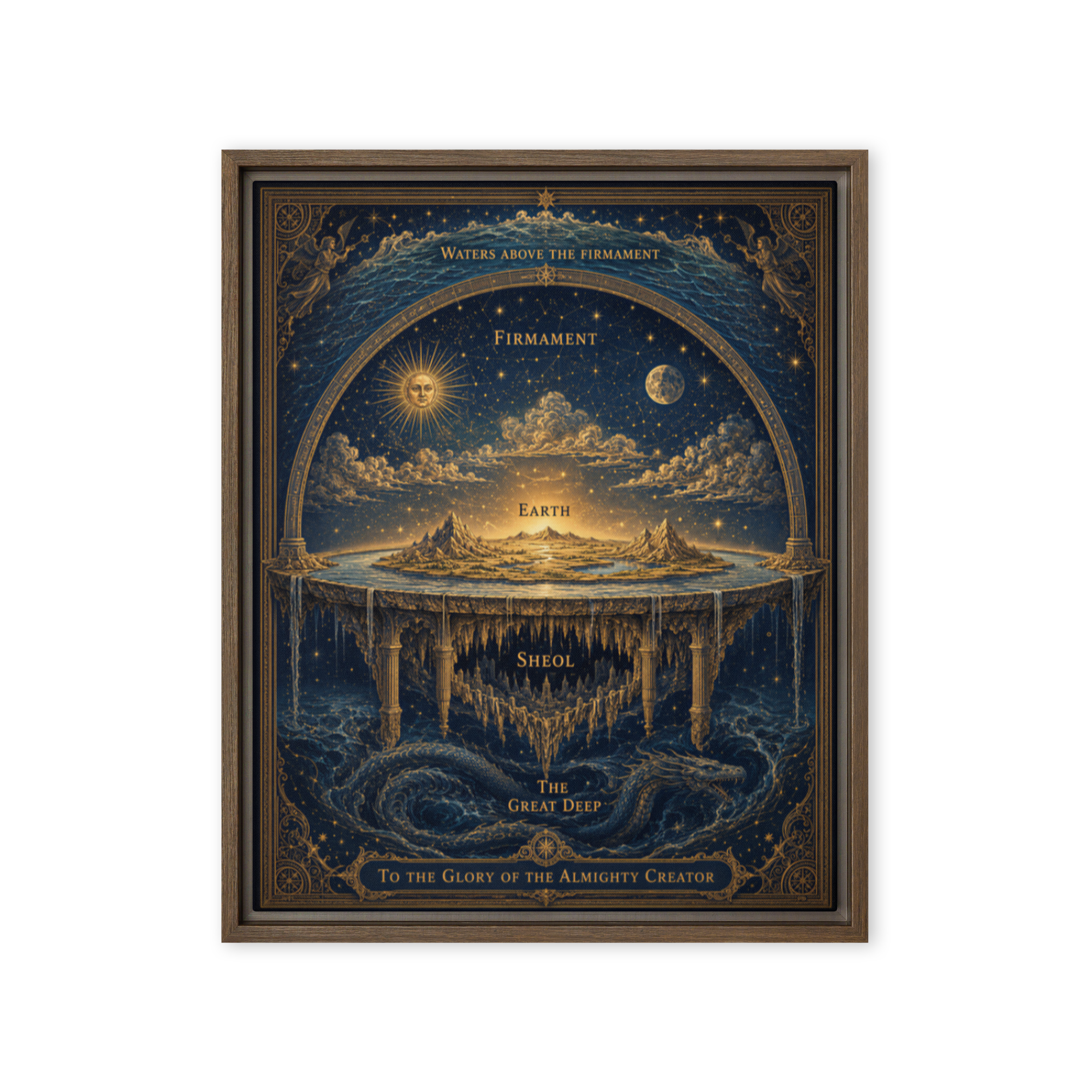
The Ancient Hebrew Cosmology canvas renders this model as its authors understood it — not as a diagram or an argument, but as a document of the world they inhabited and the God they believed made it.
Waters above the firmament, held in the vault of heaven. The firmament dome itself, with Sol and Luna set within it. The flat earth disc, mountains rising from the surface, water flowing to the edges. The foundations beneath. Sheol in the depths. The Great Deep below all of it, Leviathan moving in the dark. Angels at the corners of the frame. “To the Glory of the Almighty Creator" as the closing inscription.
This is not an alternative history product. It is a visual commentary on what the scriptures describe when you read them without the overlay of Greek cosmology. Whether you read it as literal truth, as recovered cosmological knowledge, or as the most serious piece of religious wall art you've encountered — it earns its place on the wall.
From the Archive
Ancient Hebrew Cosmology — Biblical Firmament Map Framed canvas. Museum-quality archival inks. Walnut frame. Multiple sizes. Ships worldwide.
For the biblically serious. For the cosmologically awake. For anyone who has read Genesis 1 slowly and asked what the author actually meant.
Etherfolk is an independent archive exploring time, sky observation, symbolism, and the structures that shape perception. Preserving inquiry beyond standard narratives.