
The Old World, As Preserved
Artifacts drawn from sacred cosmology, celestial maps, lost architecture, manuscript diagrams, and the symbolic systems that once shaped the visible world.
Biblical Cosmology & Sacred Order
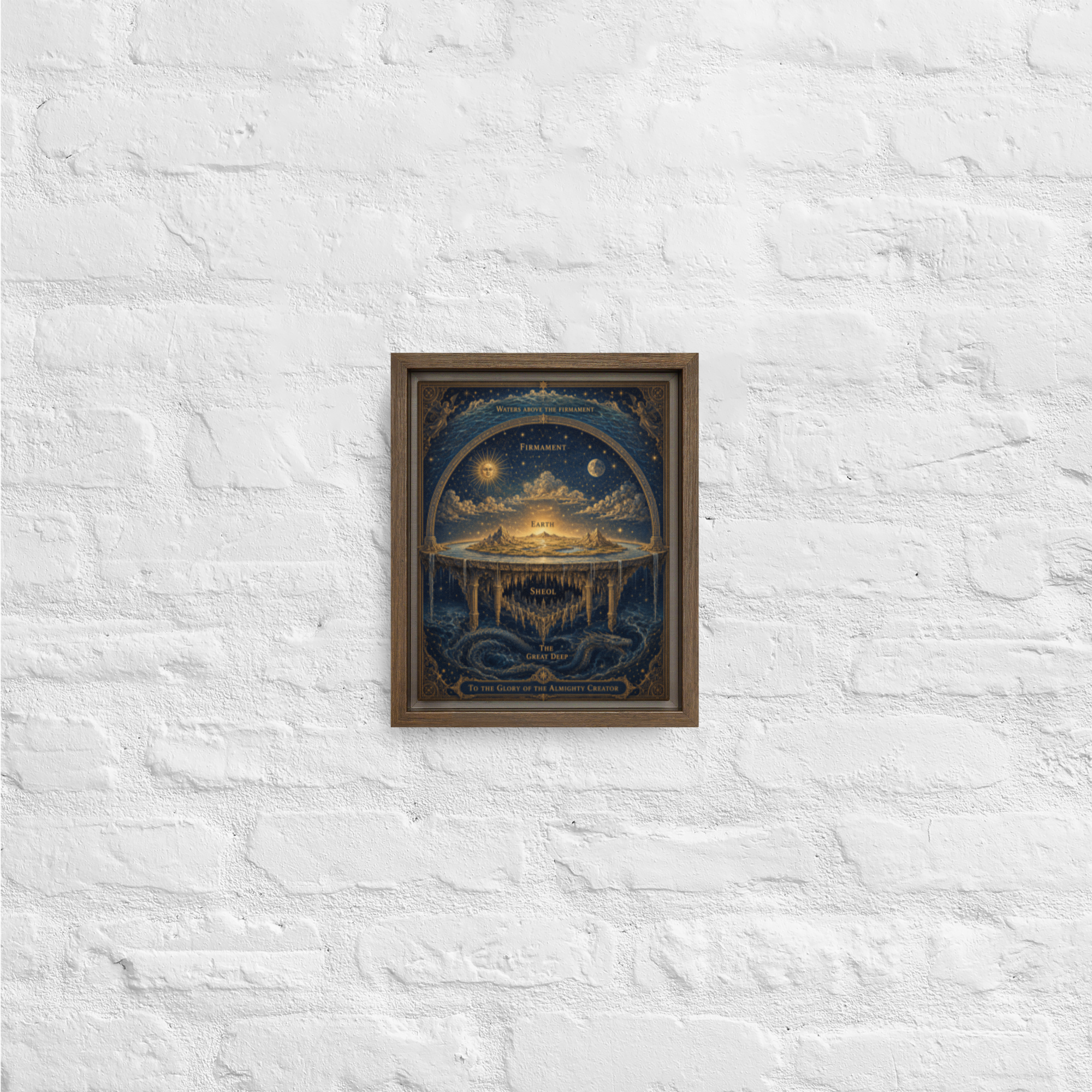
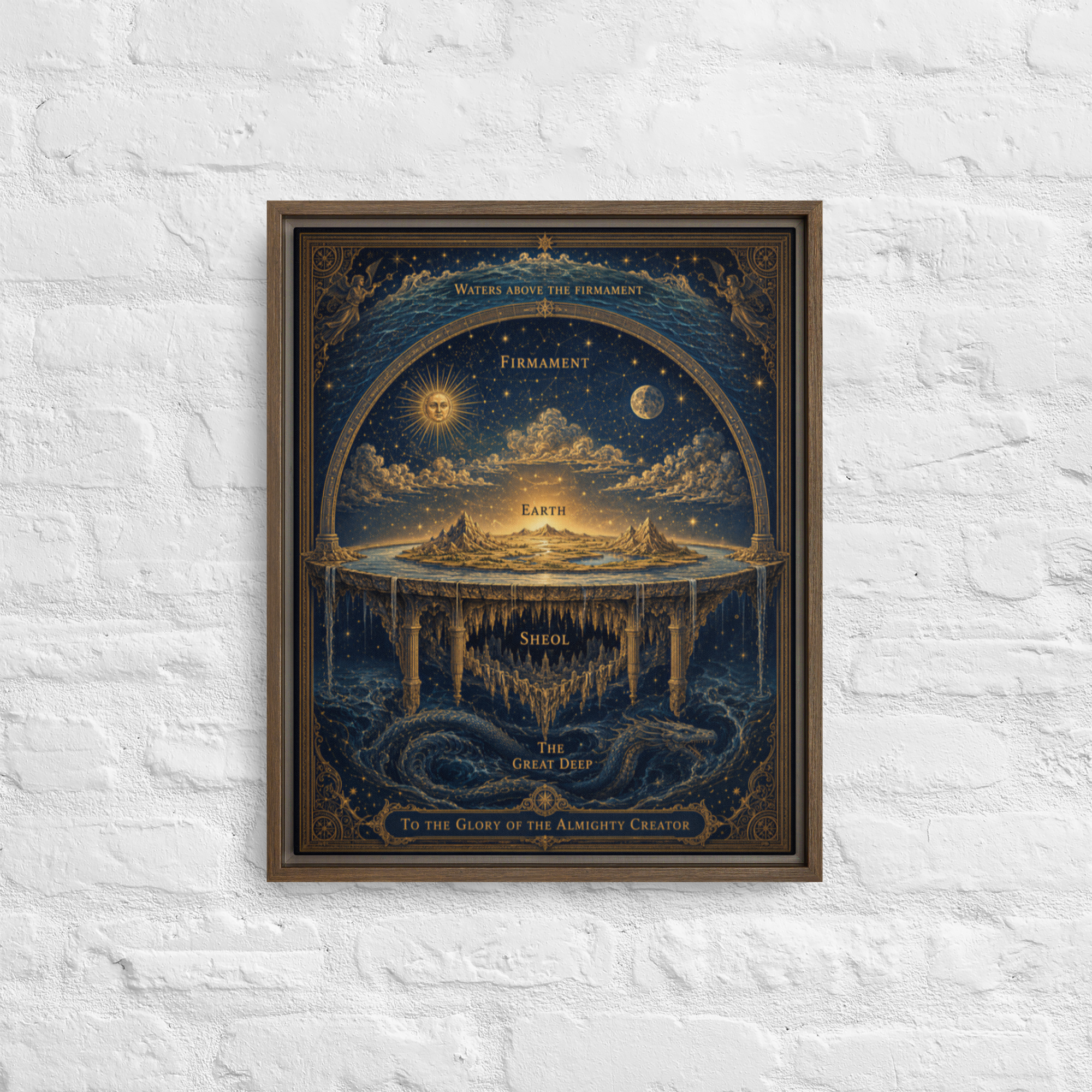
In the beginning, the waters were divided.
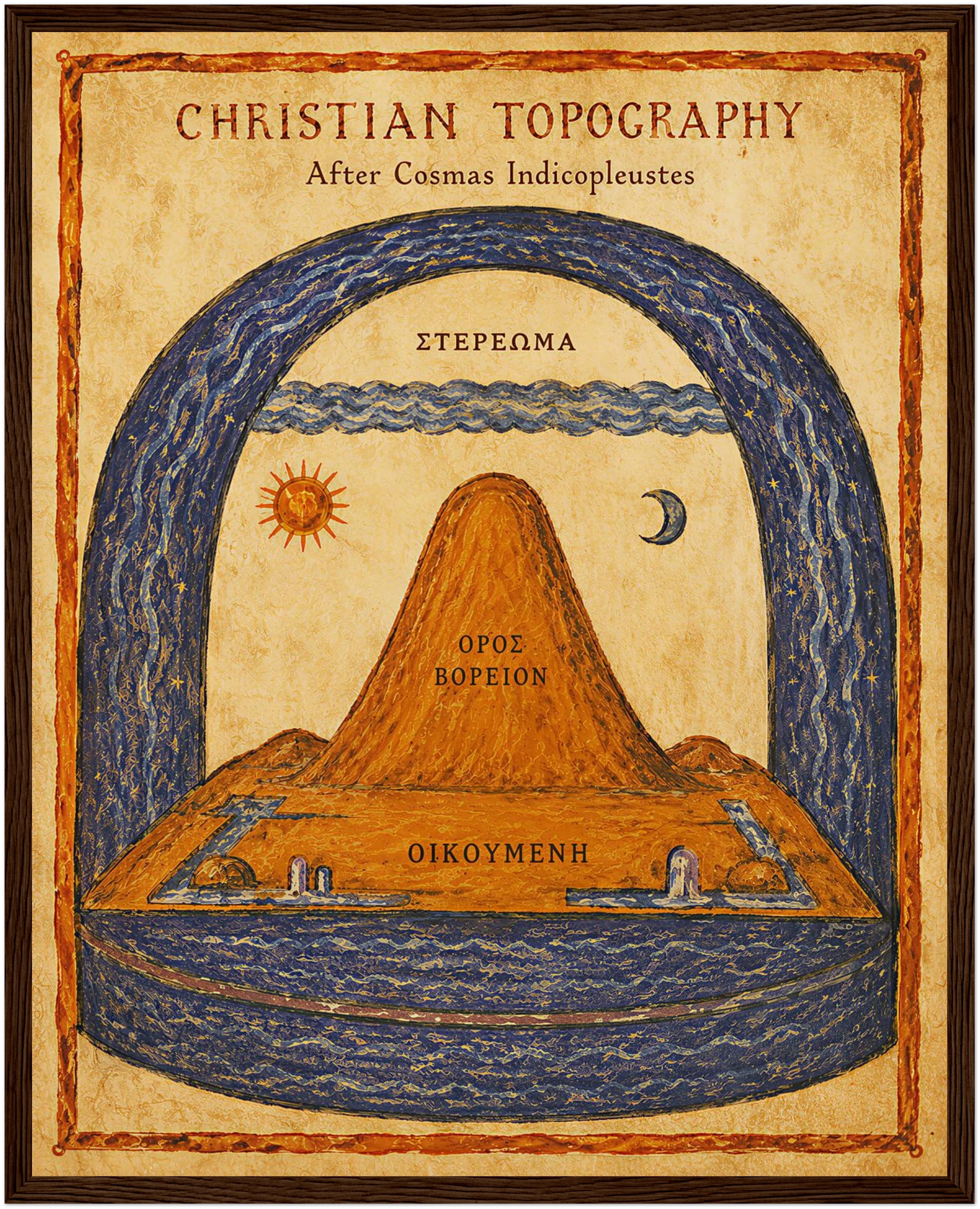
Above the firmament lie the celestial waters, with Sol and Luna tracing their appointed paths beneath the vault of heaven. Below rests the inhabited earth, its mountains rising above the deep and its rivers running toward the outer sea. Beneath the earth lies Sheol, the realm of the departed, descending through the foundations of the world. Below all is the Great Deep—the primordial abyss associated with the waters of creation and the dark dwelling of Leviathan.
This original Etherfolk reconstruction brings together cosmological imagery found across Genesis, Job, the Psalms, and related ancient Jewish texts. Rather than reproducing one surviving historical diagram, it gathers those scriptural elements into a single visual model of the biblical world: the firmament above, the inhabited earth below, Sheol beneath, and the Great Deep at the foundation.
Rendered in antique gold against deep navy, the composition draws from the visual language of medieval illuminated manuscripts and sacred cosmological charts. Angels occupy the corners, the created order unfolds through clearly defined strata, and the inscription at the base reads, “To the Glory of the Almighty Creator.”
The piece is intended as a work of sacred cosmological art: a modern reconstruction shaped by Scripture, historical interpretation, and the long visual tradition of giving structure to the heavens, the earth, and the deep.
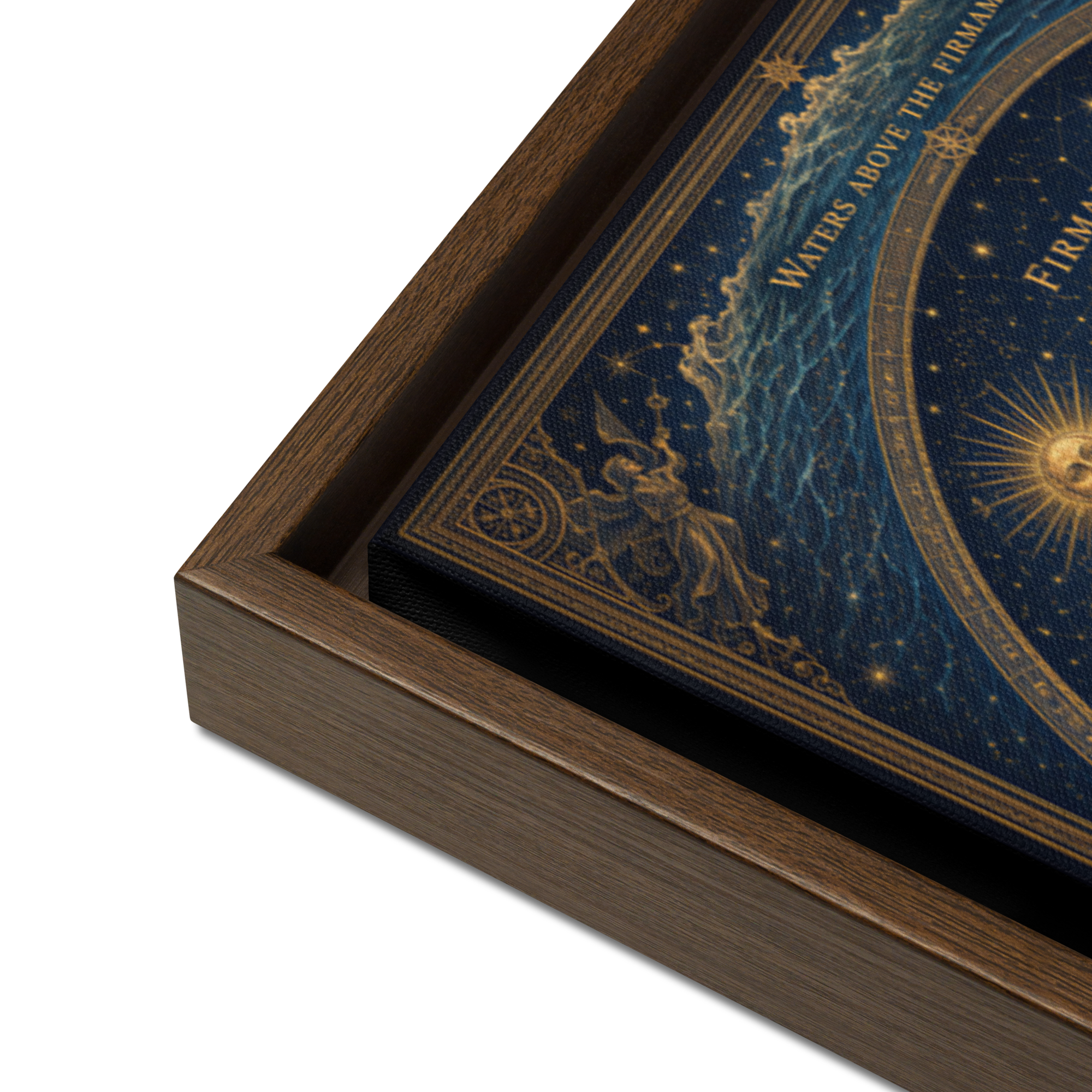
Printed on heavyweight artist-grade canvas and mounted within a solid pine floating frame, it arrives ready to hang. The recessed open-back construction allows the canvas to sit within the frame with a narrow surrounding gap, giving the work a restrained, architectural presence.
— Premium artist-grade canvas, 344 g/m²
— Solid pine floating frame with walnut finish
— Approximately 1.25″ frame depth
— Hanging hardware included
— No assembly required
— Available in multiple sizes
— Newly produced and made to order
Part of the Etherfolk Cosmology Collection.
The waters were divided. The firmament was set in place. The record remains in the text.
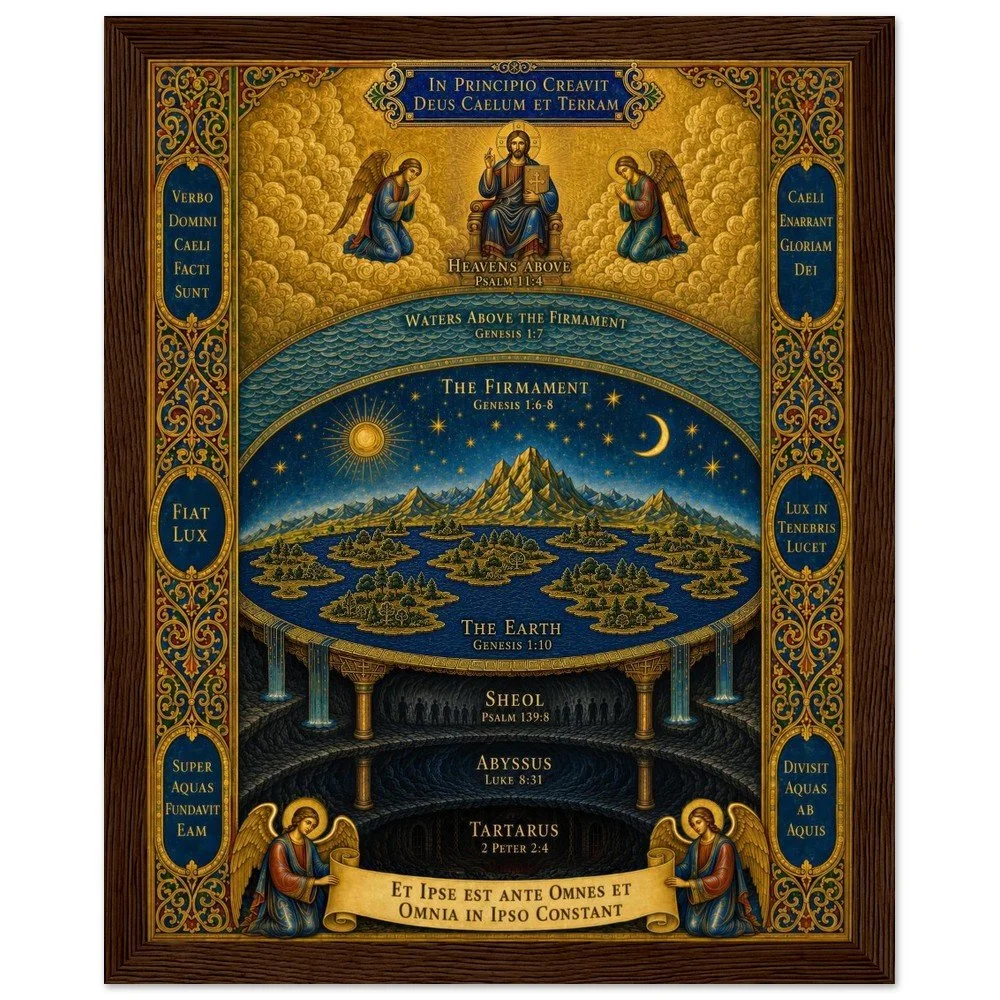
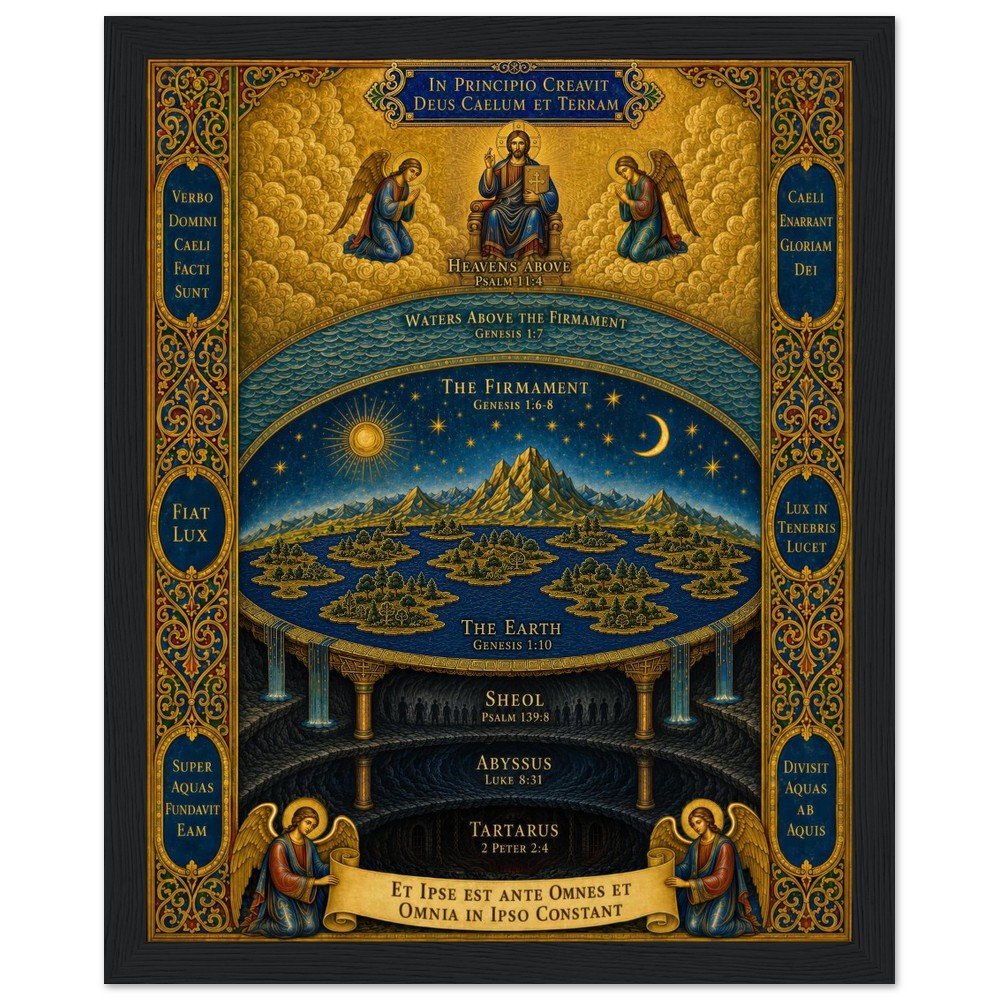
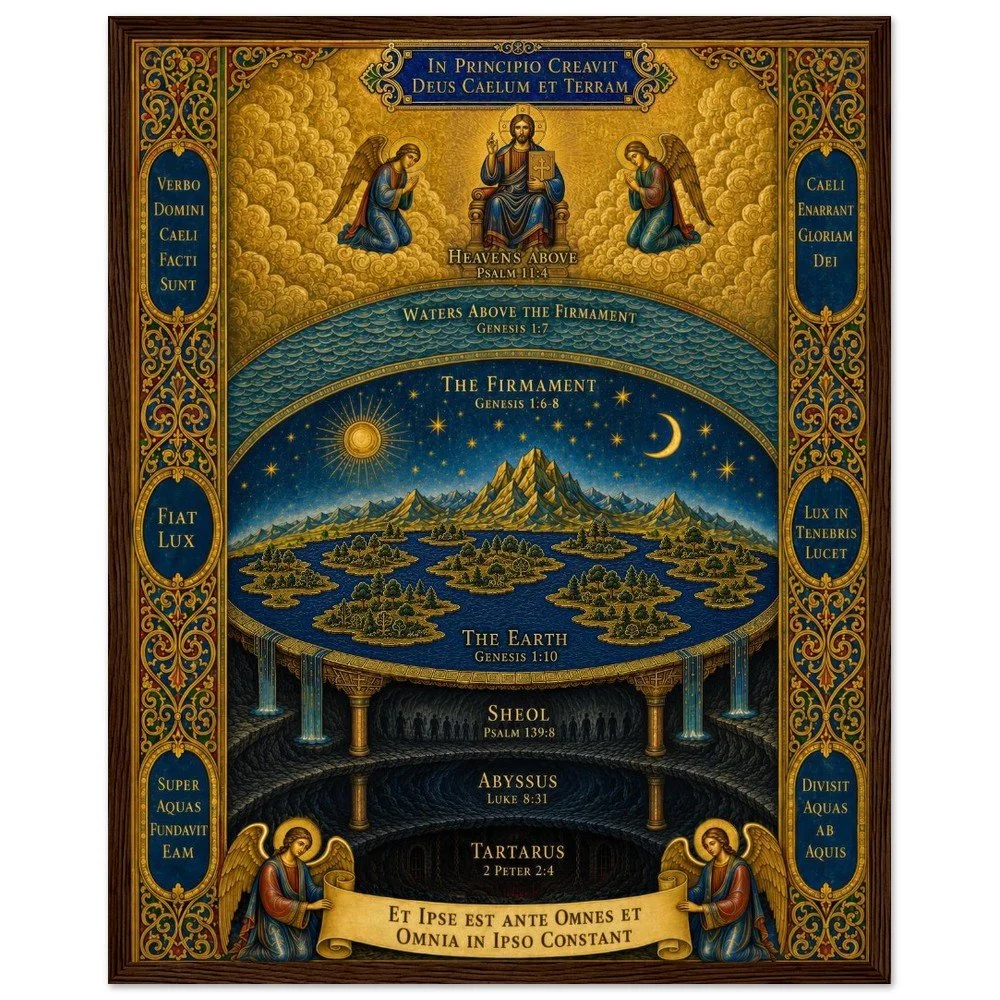
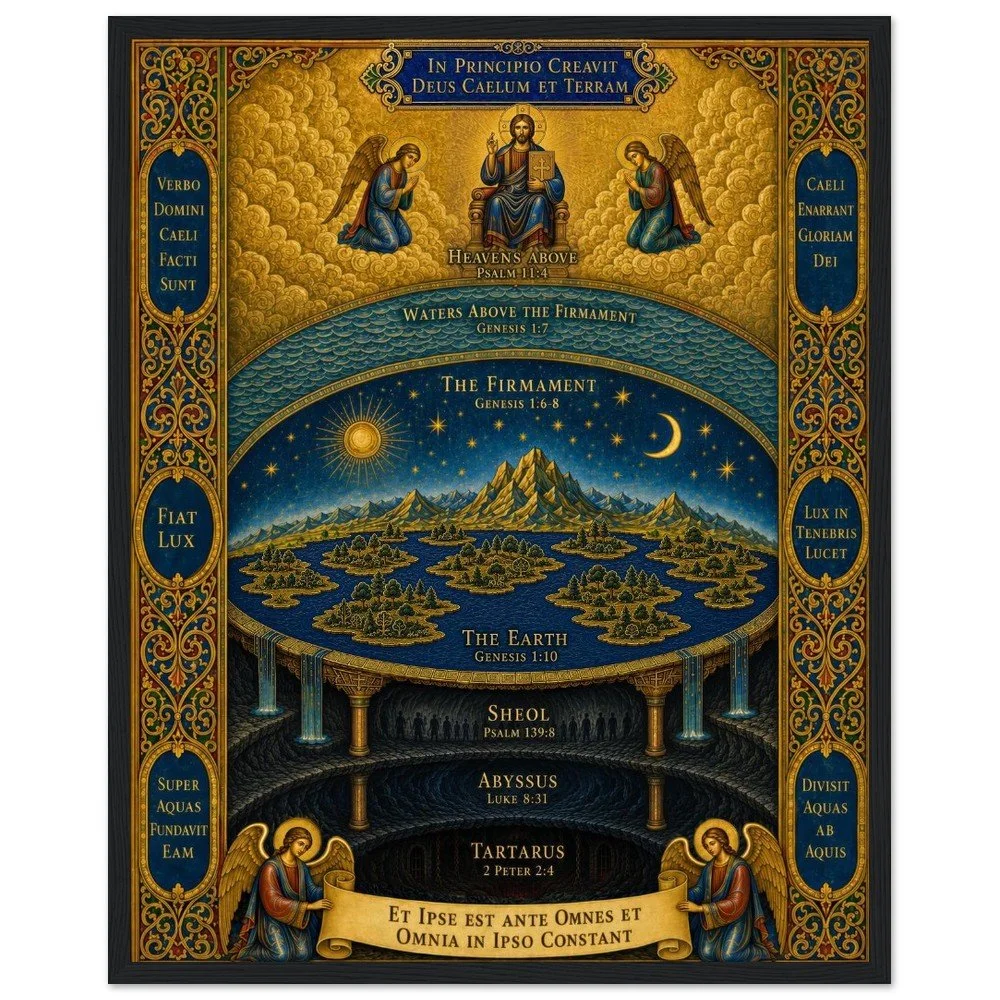
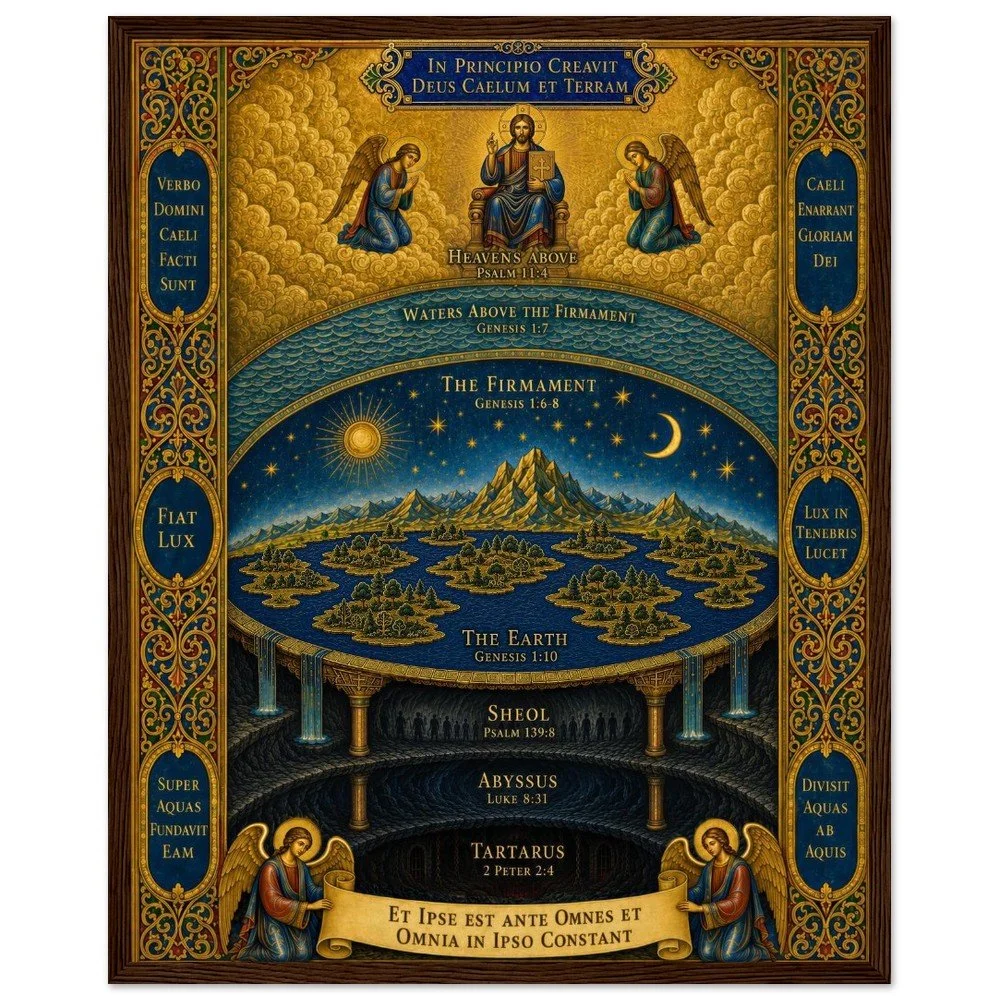
Framed poster mapping the Christian cosmological order as a medieval illuminated manuscript, from Christ enthroned above to Tartarus below.
“In principio creavit Deus caelum et terram.”
In the beginning God created the heaven and the earth.
Genesis 1:1
Rendered with floral vine borders, angelic figures, gold-leaf ornament, Latin Scripture inscriptions, and labelled strata, this piece sets the older biblical order into a formal manuscript plate.
The image descends from Christ enthroned in the heavens through the Waters Above the Firmament, the Firmament, the inhabited Earth, Sheol, Abyssus, and Tartarus. Each region is marked with its corresponding Scripture reference, preserving the structure as both devotional image and archival diagram.
For prayer rooms, studies, libraries, church offices, and walls where the record is still allowed to remain visible.
Details:
• Ready-to-hang framed poster with hanging kit included
• Durable pine wood frame
• Frame measurements: 20–25 mm / 0.79"–0.98" thick, 10–14 mm / 0.4"–0.6" wide
• Matte, smooth, non-reflective paper finish
• Shatterproof plexiglass protects the poster
• FSC-certified materials or equivalent
• Medieval illuminated manuscript style
• Includes Latin Scripture inscription and labelled biblical cosmology layers
Part of the Ancient Cosmologies series.
The heavens were not left unmarked.
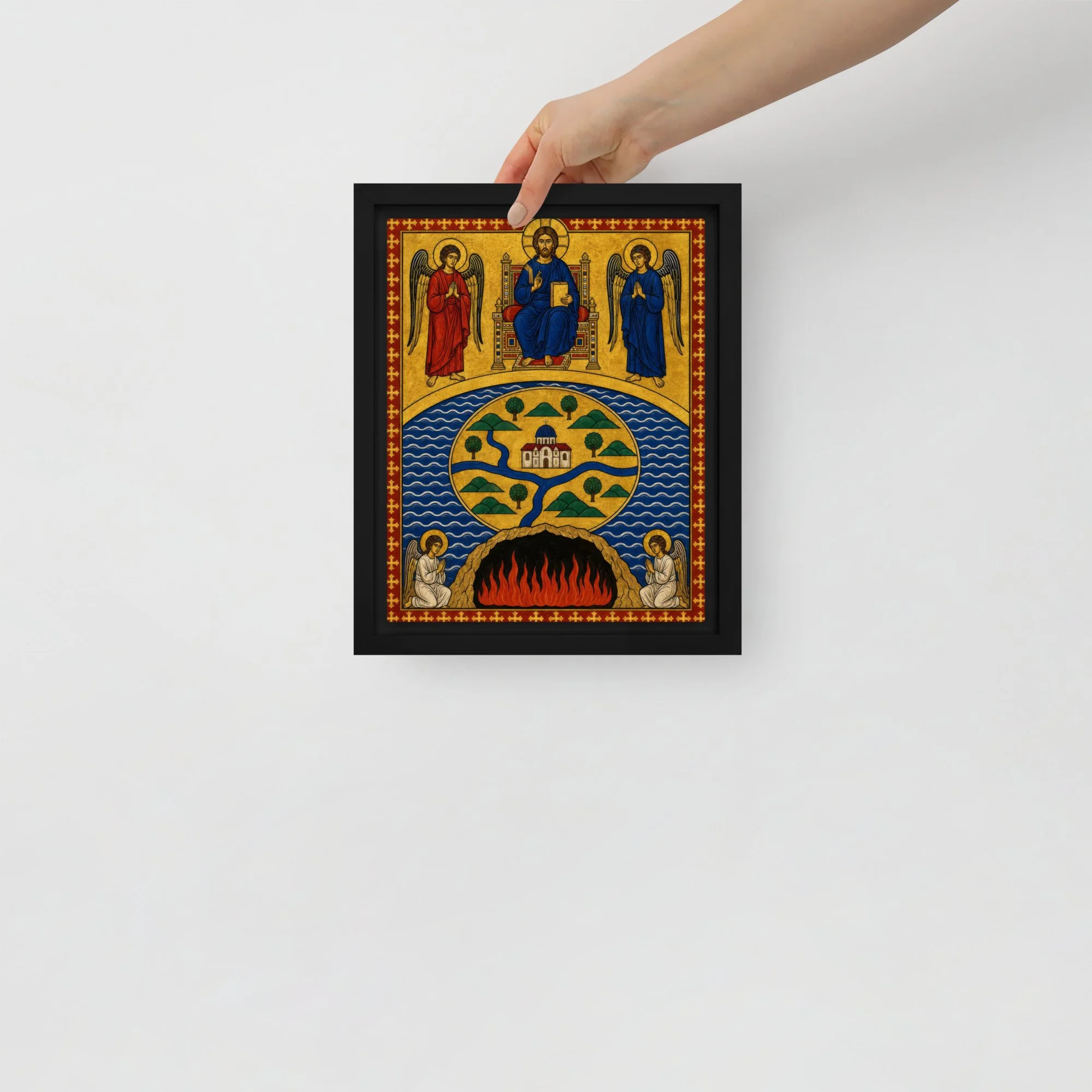
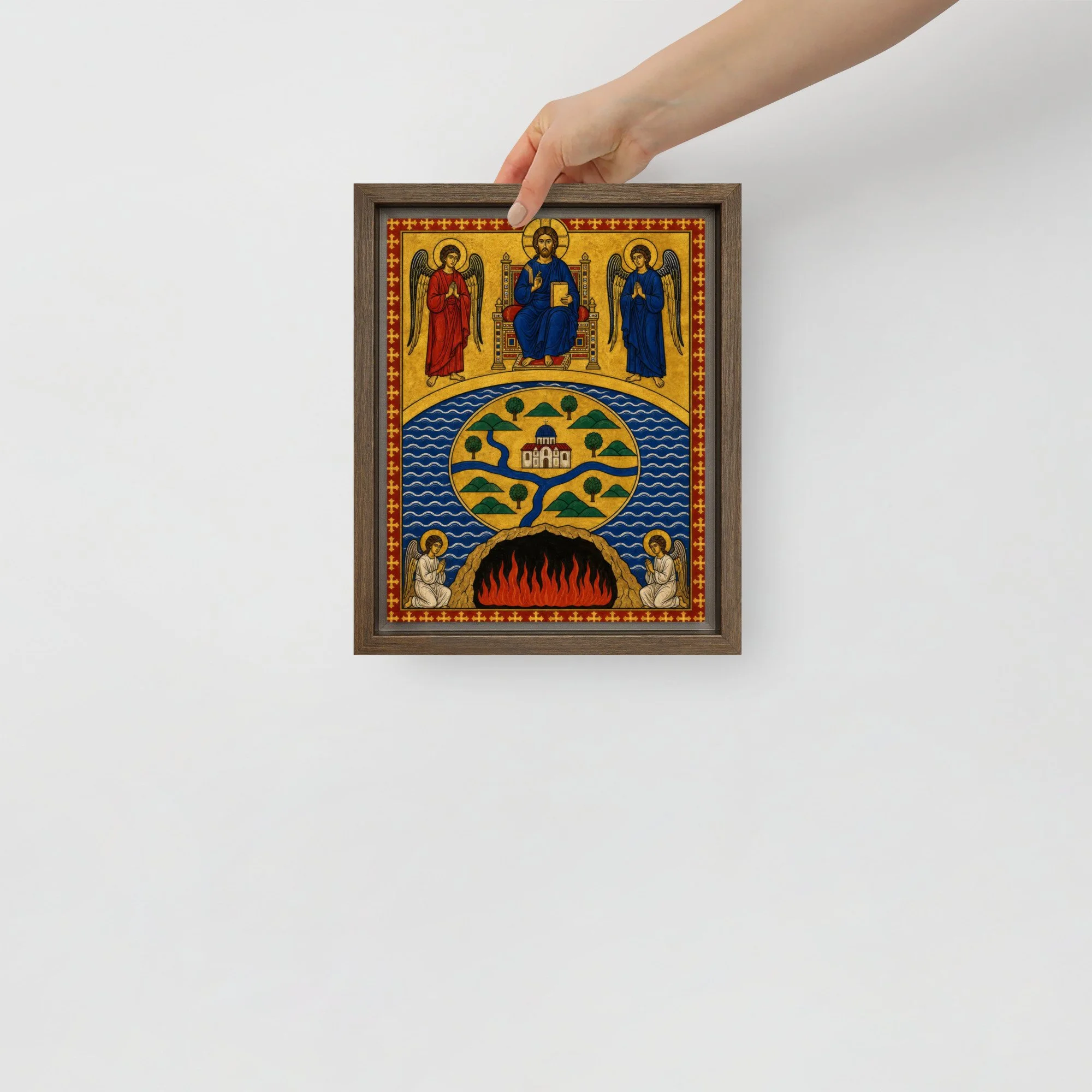
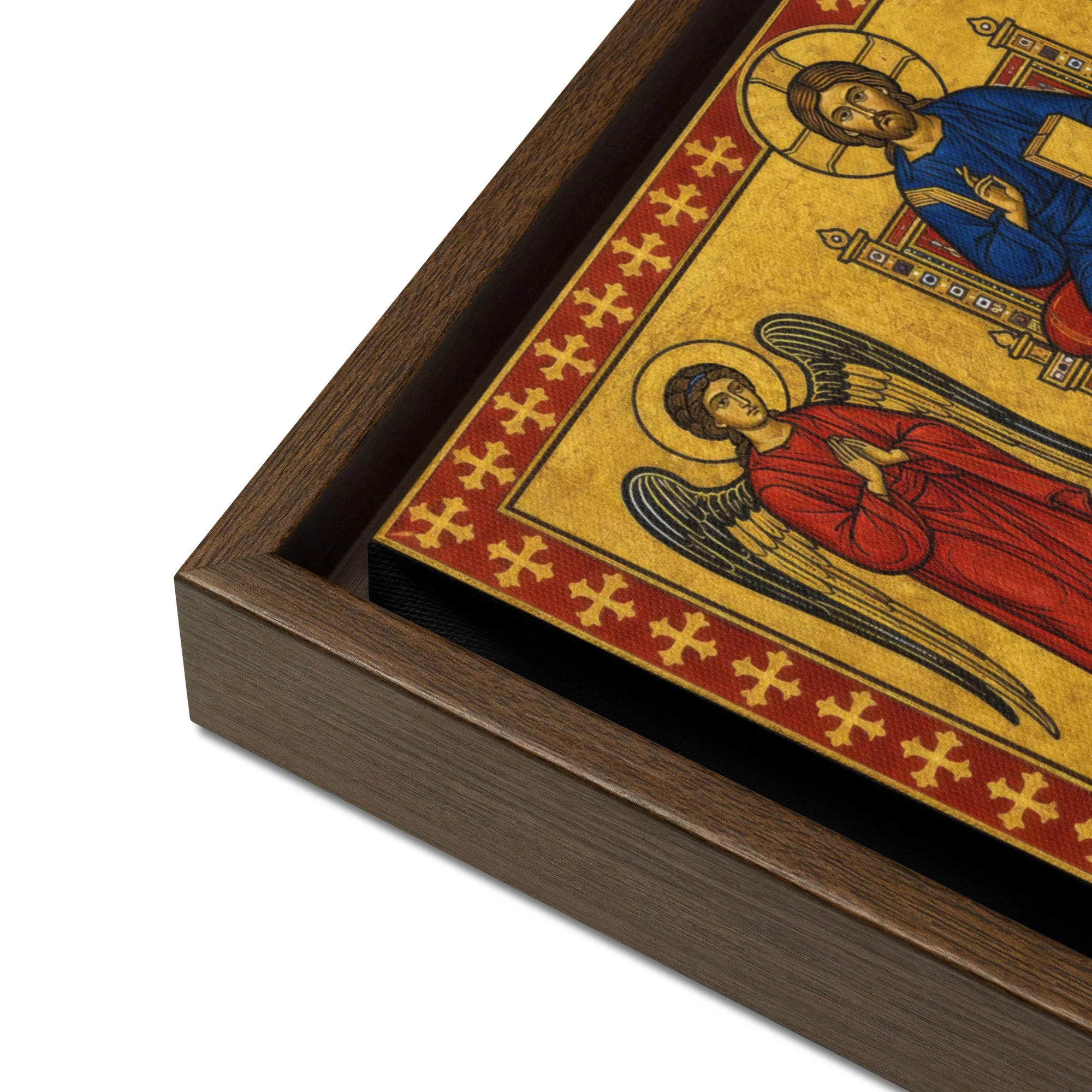
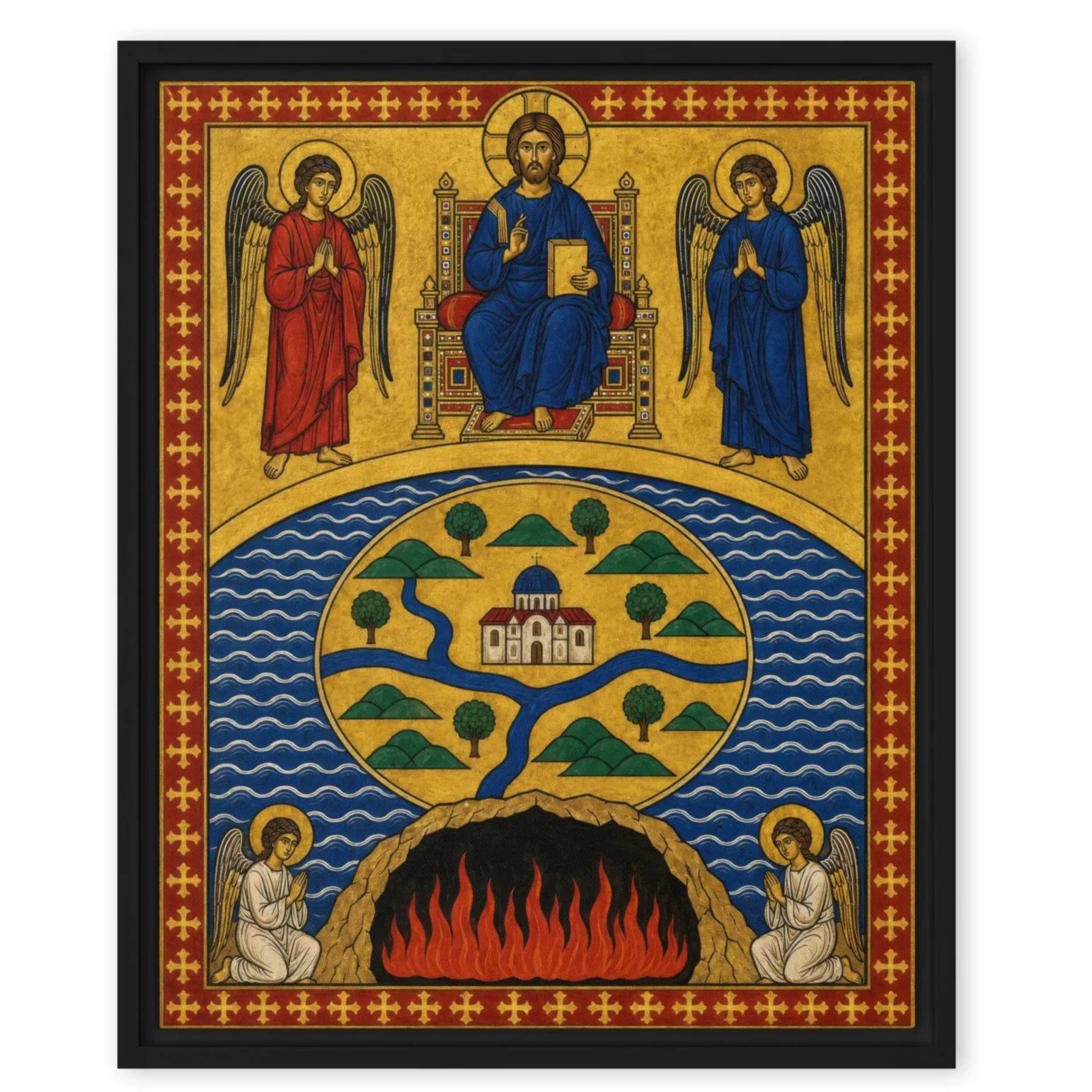
"In the beginning God created the heaven and the earth." — Genesis 1:1
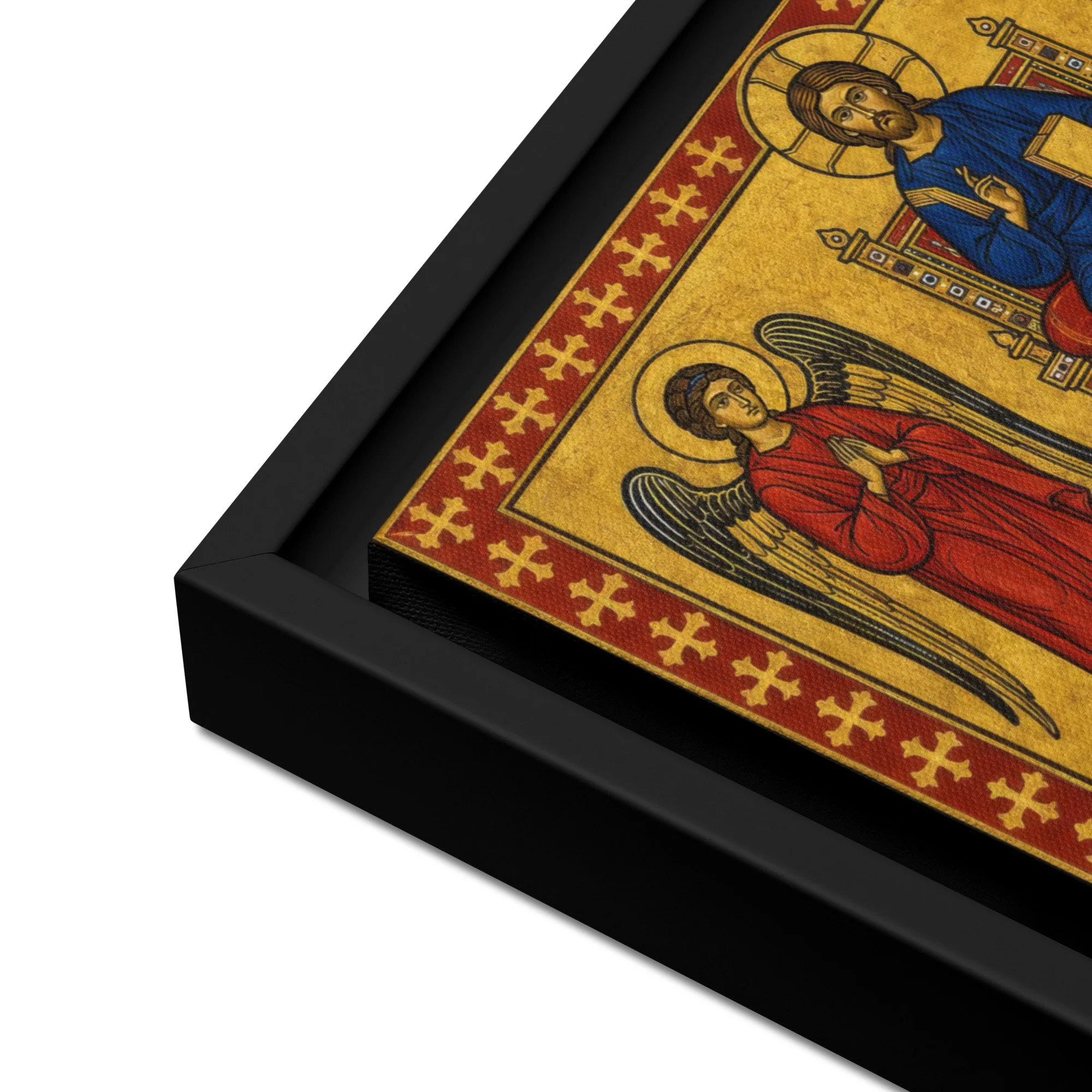
Christ Pantocrator sits enthroned above the created order, set against a field of gold and attended by two archangels. Beneath Him, the firmament forms the boundary between the heavens and the inhabited world below. The earth appears as a bounded disc surrounded by sea, with church, river, and mountain arranged across its surface. Below, Sheol opens through the foundations as a dark cavern, fire visible within, while four angels kneel at the corners of the composition.
This original Etherfolk composition draws on Byzantine iconography, biblical cosmological imagery, and the ordered visual language of illuminated manuscripts. It does not reproduce one surviving historical icon. Instead, it gathers these elements into a single sacred cosmological plate: Christ above, the firmament between, the inhabited earth below, and Sheol beneath the world.
Rendered in deep blue, antique gold, ivory, and warm ink-black, the piece is designed to carry the gravity of an icon while remaining clear about what it is: a modern work shaped by Scripture and historic Christian visual tradition.
Printed on heavyweight artist-grade canvas and mounted within a solid pine floating frame, it arrives ready to hang. The open-back construction gives the canvas a restrained, architectural presence without unnecessary ornament.
Details
• Premium artist-grade canvas, 344 g/m²
• Solid pine floating frame
• Frame depth: 1.25″ / 3.18 cm
• Open-back construction
• Rubber pads on the back corners
• Hanging hardware attached
• Ready to hang
• Blank product sourced from the United States
• Newly produced and made to order
Part of the Etherfolk Biblical Cosmology Collection.
The order of creation, rendered in gold and pigment.
Etherfolk makes archival objects inspired by older maps, sacred diagrams, scriptural cosmology, forgotten architecture, and the records left outside the authorized account.
Each piece is designed to feel like a recovered plate, field emblem, manuscript fragment, or civic relic.
Tartarian Architecture & Old World Forms
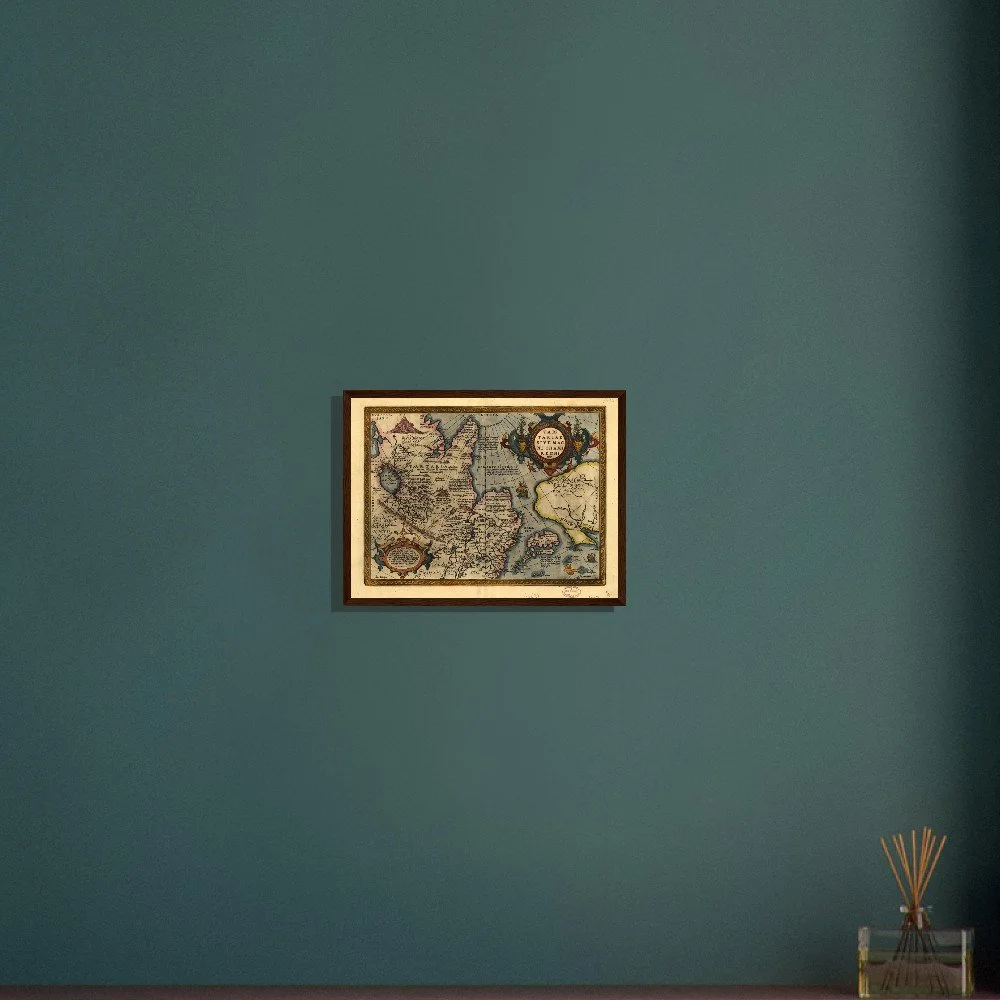
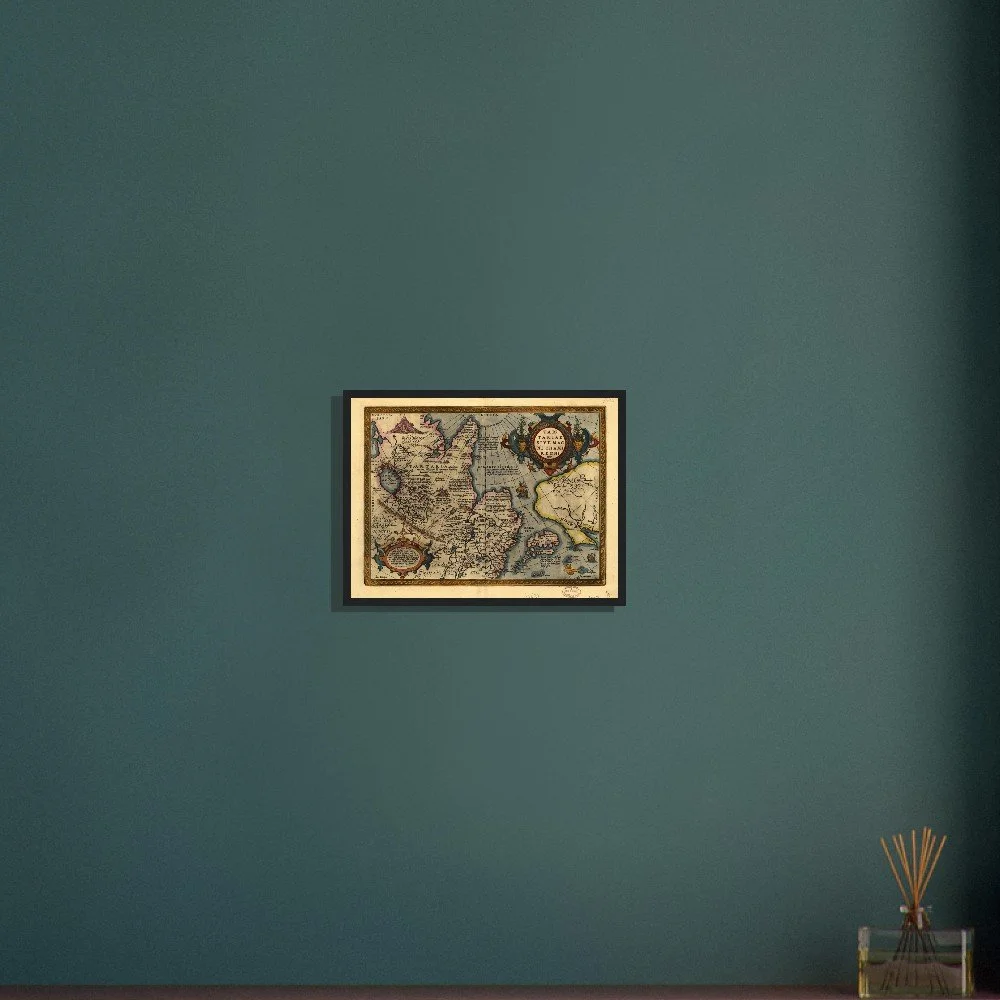
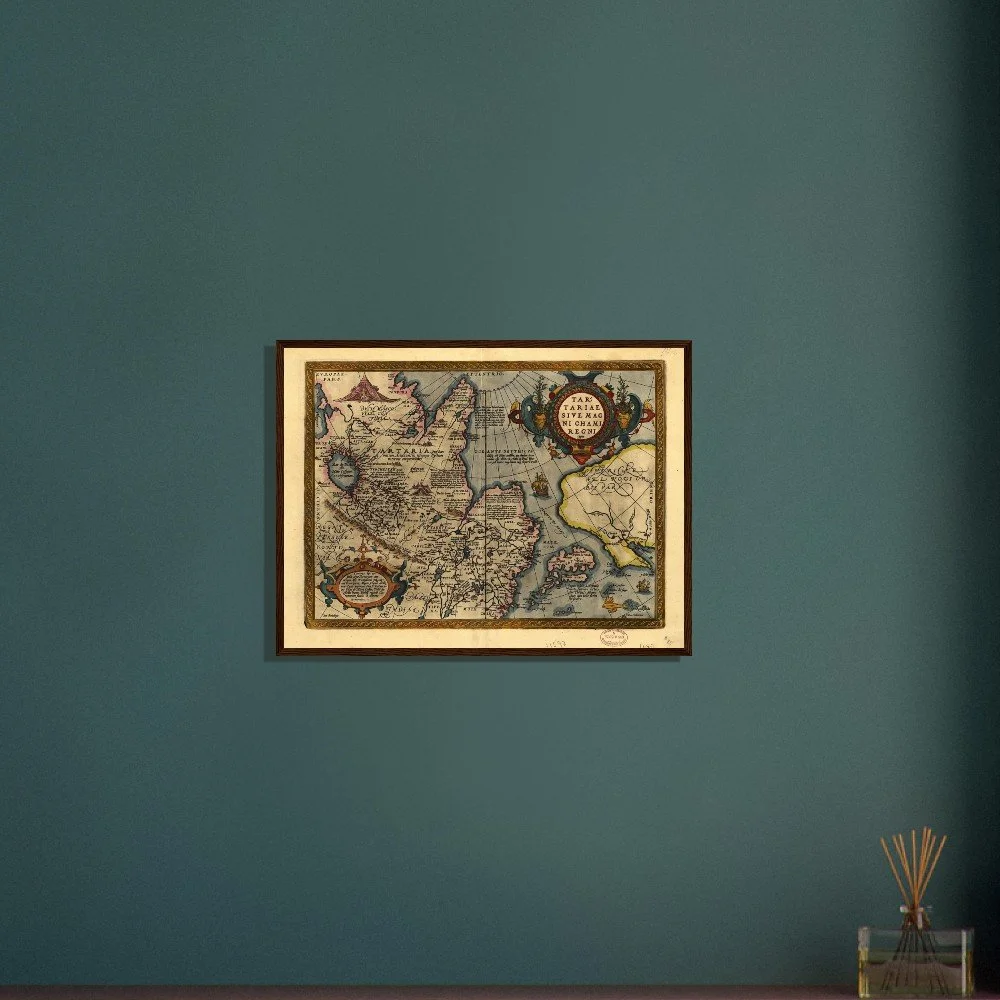
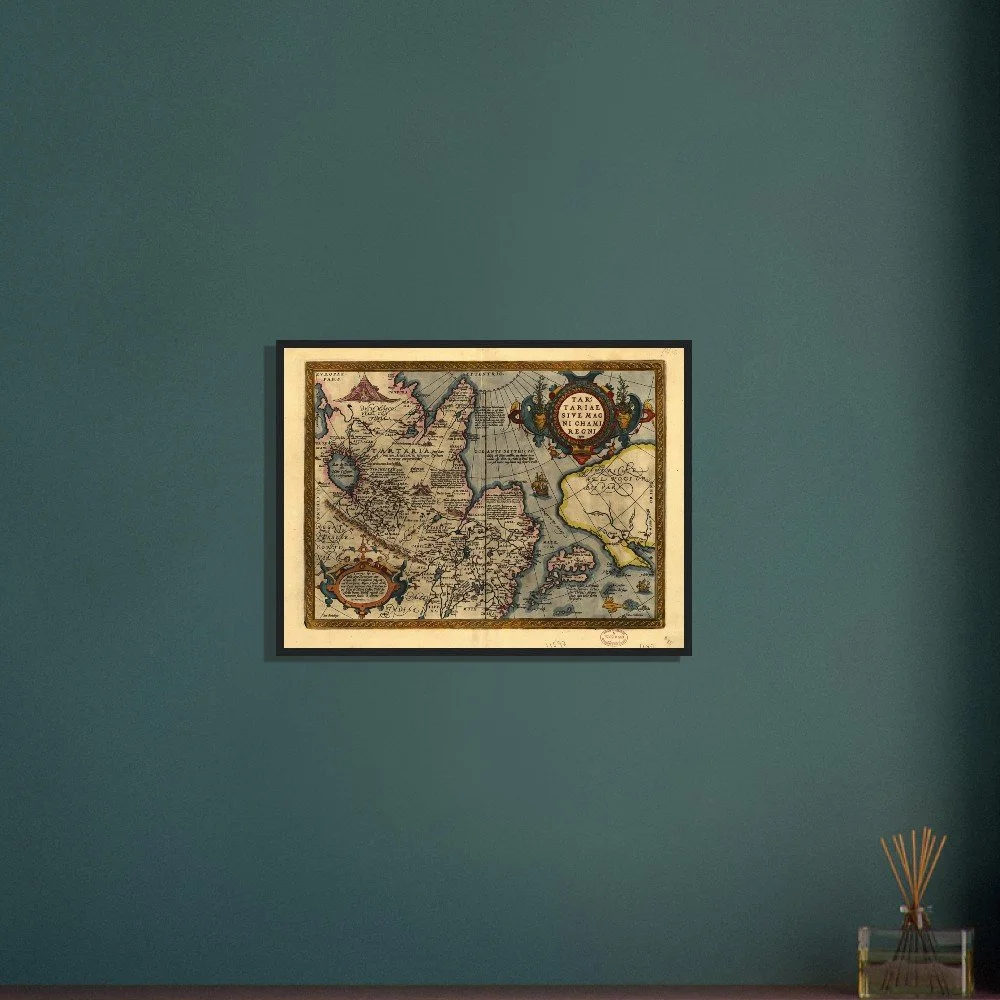
Before the griffin, there was the dragon.
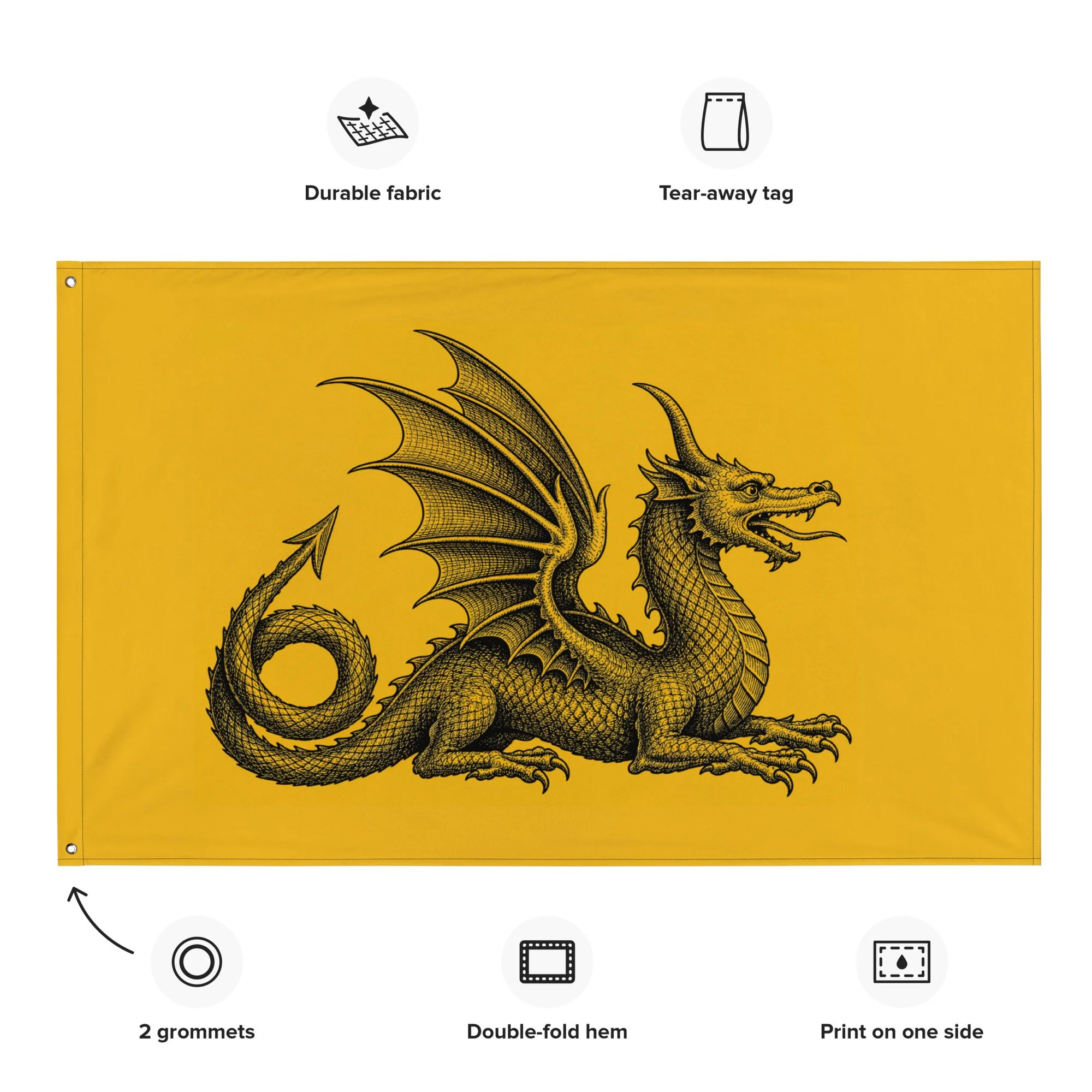
The flag most often sold as the "Tartarian griffin" is a modern cleanup of something older and stranger. The period sources describe it plainly: in Carel Allard's record of 1705, the standard of the king of Tartary is a black dragon — a great serpent with a basilisk tail, couchant, facing the fly, on a field of gold.
This is that flag, rendered faithfully from the description and the surviving 18th-century flag charts. The coiled serpentine tail. The raised wings. The creature lying in wait rather than standing in heraldic pose. It is the emperor's standard as the old records actually set it down — not the version the present age tidied into a griffin.
Printed on durable flag fabric, vivid and sharp. Built to hang as what it is: a recovered standard.
Details
• 100% polyester
• Knitted fabric
• Fabric weight: 4.42 oz/yd² (150 g/m²)
• Print on one side
• Blank reverse side
• 2 brass grommets for hanging
• Drawn from Allard's 1705 description and period flag records
Part of the Etherfolk Tartaria Collection.
The serpent came first. The griffin came later.
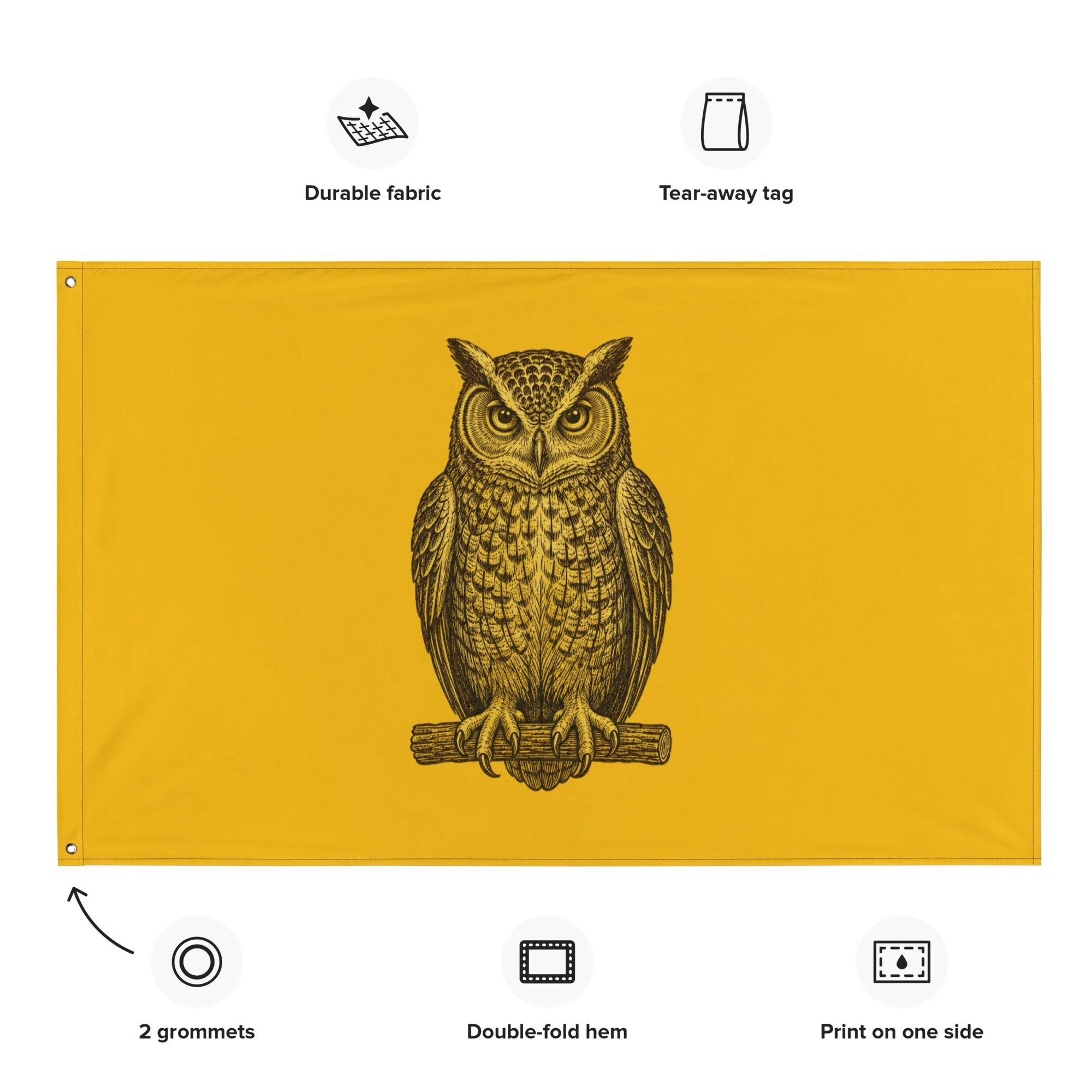
The crest came before the standard.
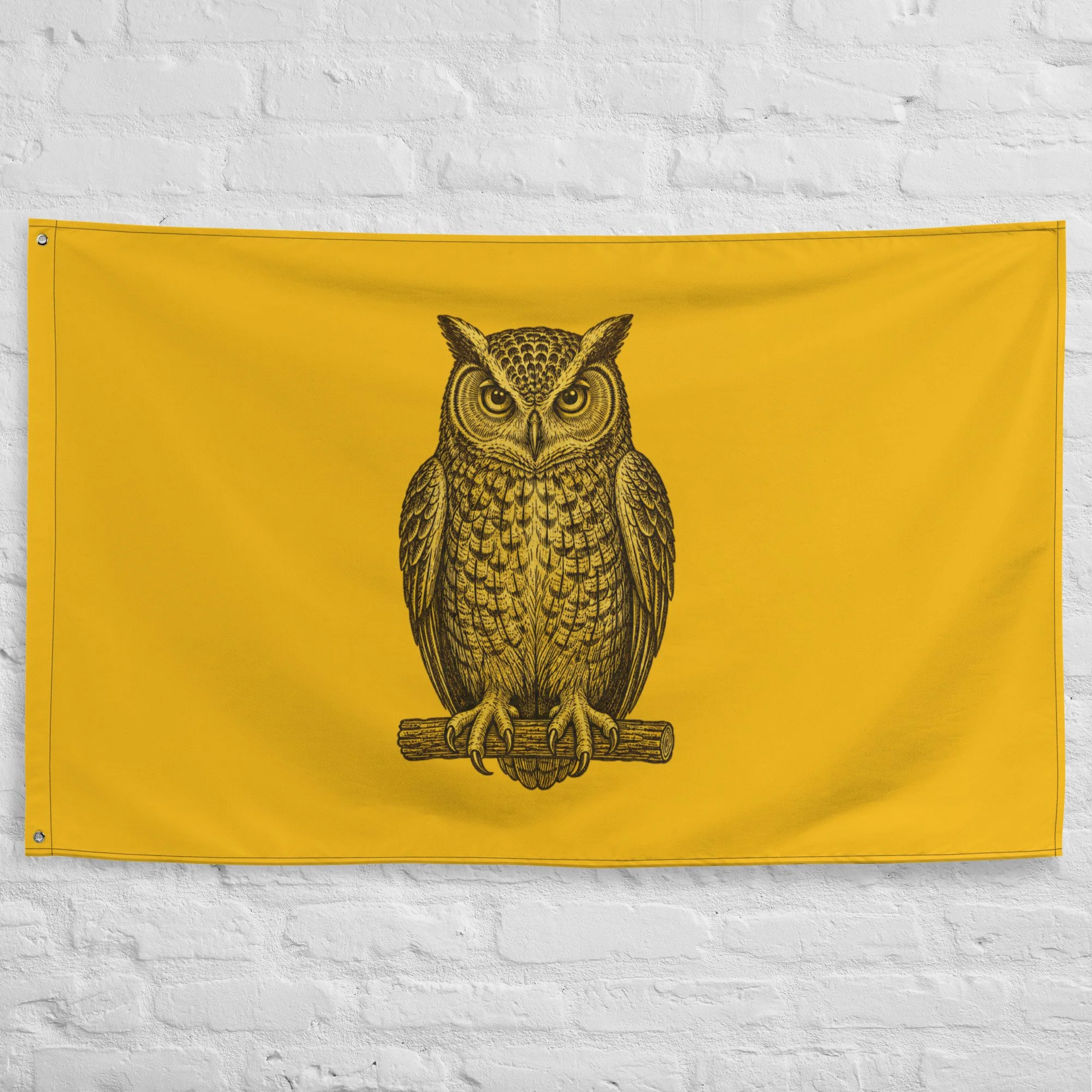
While the emperor flew the dragon, the territory itself carried an older emblem: the owl. It appears in the World Geography published in Paris in 1676, where the article on Tartary is preceded by the image of an owl on a shield — the heraldic device of the land, set down in the geographic record more than three centuries ago.
This is that emblem, rendered in faithful engraving style — the owl forward-facing, perched, talons gripping, in the manner of the period sources. No embellishment, no invention. The crest of Tartary as the old geographies recorded it, on a field of gold.
It is the quieter of the two Tartarian emblems. The one that stood for the place rather than the ruler. For those who prefer the territory to the throne.
Details:
• 100% polyester
• Knitted fabric
• Fabric weight: 4.42 oz/yd² (150 g/m²)
• Print on one side
• Blank reverse side
• 2 brass grommets for hanging
• Drawn from the 1676 Paris World Geography
Part of the Etherfolk Tartaria Collection.
The dragon ruled. The owl watched.
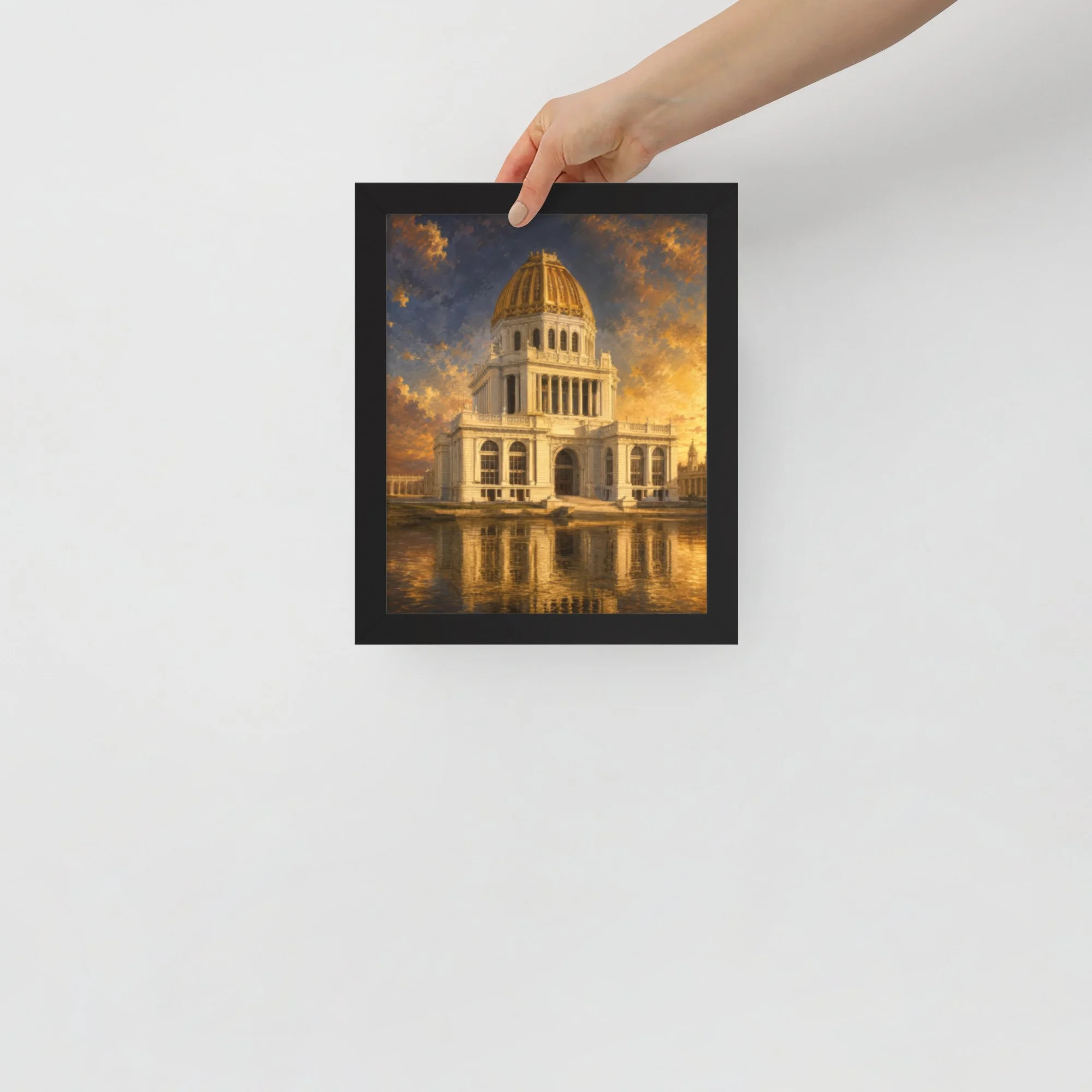
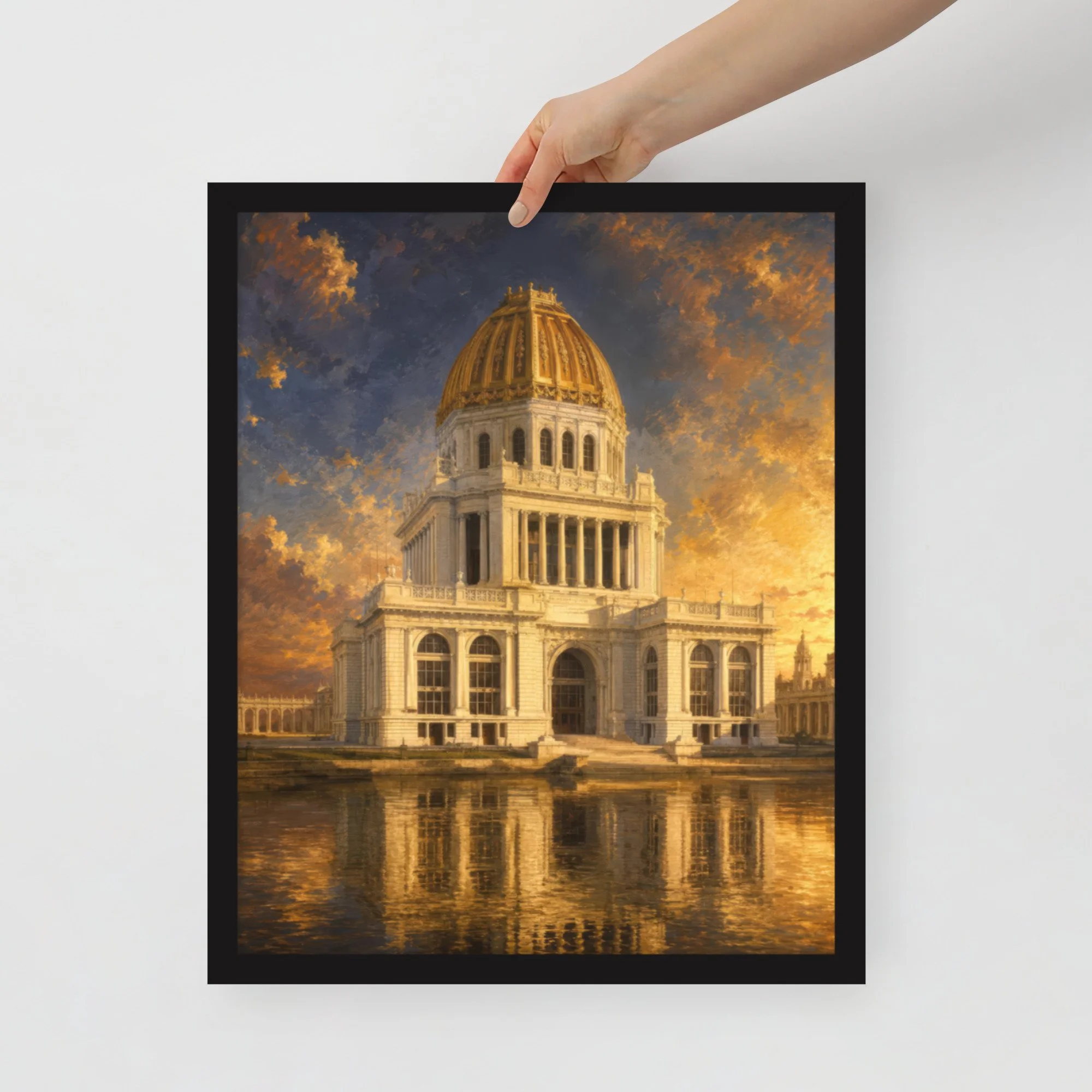
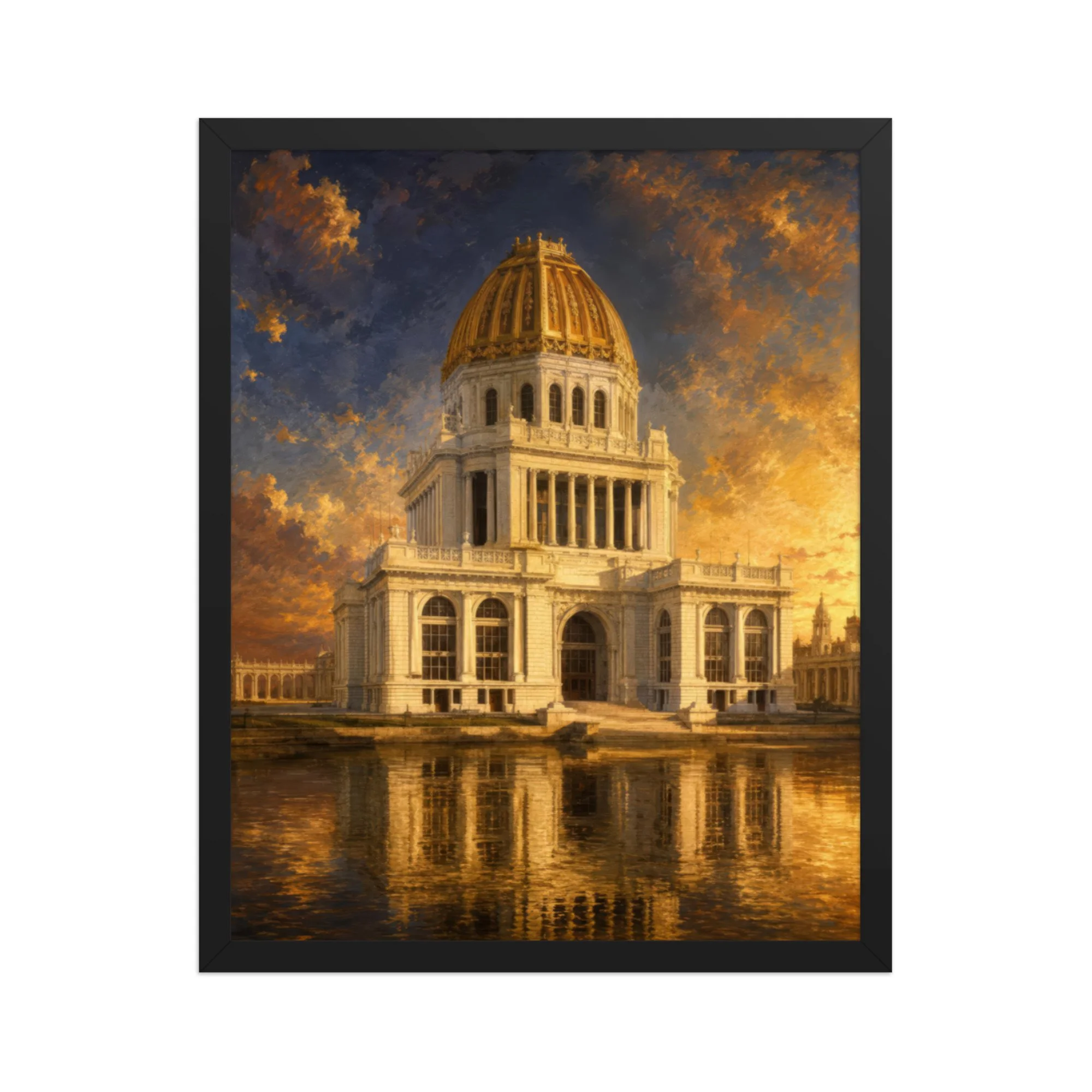
The Administration Building of the 1893 World's Columbian Exposition, Jackson Park, Chicago. Designed by Richard Morris Hunt. A gilded dome larger than the United States Capitol. Four Ionic colonnaded pavilions. An octagonal drum no modern construction crew would attempt on a two-year timeline. Forty thousand workers on swampy terrain. Painted plaster over iron and wood — the official story.
It burned in July 1894. One year after the fair closed.
This painting does not accept the timeline. Rendered in a Romantic painting style — warm amber light, Prussian blue sky, the Grand Basin reflecting gold on dark water. The building as it stood before the record was settled and the rubble was cleared.
What was built here, and by whom, and when — these remain open questions.
Every room it enters will eventually ask them.
Details:
• Ayous wood frame, .75″ (1.9 cm) thickness, from renewable forests
• Paper thickness: 10.3 mil (0.26 mm)
• Paper weight: 189 g/m²
• Lightweight
• Acrylite front protector
• Hanging hardware included