
What Is the Mud Flood Theory? A Visual Archive
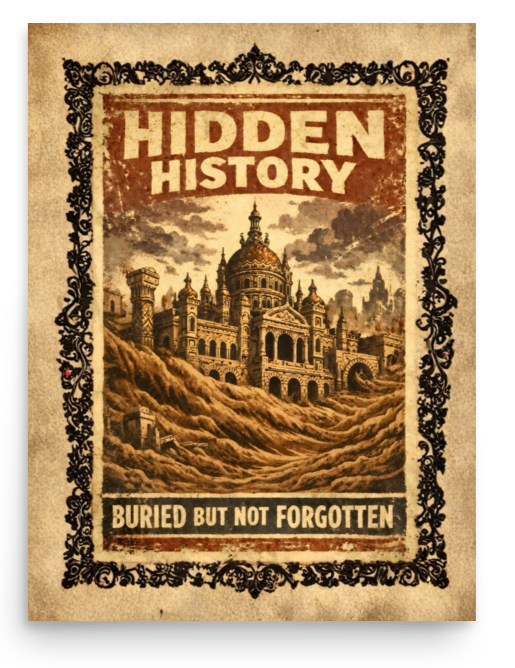
Buried but not Forgotten
— from the Etherfolk Hidden Histories Collection.
Beneath the streets of nearly every major city in the world, there are buildings with anomalies that mainstream history cannot comfortably explain. Windows that begin below the present pavement line. Doorways that descend rather than ascend. Ground floors that function as basements in buildings whose architectural grammar was never designed for underground living. Grand arched openings that face the earth rather than the sky.
The mud flood theory offers an explanation. Not an easy one. Not an officially sanctioned one. But one that, once encountered, is difficult to look away from.
This is the archive.
What the Mud Flood Theory Claims
The mud flood theory holds that sometime in the 18th or 19th century — the dates vary depending on the researcher, the region, and the evidence being examined — a catastrophic event of planetary scale deposited enormous quantities of sediment across vast areas of the Earth's surface. Not a gradual geological process. Not centuries of slow accumulation. A single event, or a compressed series of events, that raised ground levels by meters in a matter of years or decades.
The civilization that existed before this event — variously identified with the Tartarian Empire, the Old World, or the pre-reset world — was advanced in ways that current historical frameworks do not account for. Its architecture was grand, ornate, and built to endure. Its infrastructure was sophisticated. Its cities were designed for a ground level that no longer exists.
When the mud came, it did not destroy these cities outright. It buried them. The buildings remained structurally intact beneath the sediment. Over time, the survivors — or the inheritors — simply continued building on top of the new ground level, incorporating the upper floors of the buried structures as foundations for the new world they were constructing. What had been ground-floor grand entrances became basement doors. What had been street-level windows became subterranean apertures. What had been a living city became, floor by floor, an underground archive of a civilization that history decided to forget.
This is the core of the mud flood theory. Everything else — the Tartarian connection, the reset narrative, the suppressed records — flows from this central claim about the physical evidence visible in the architecture.
The Architectural Evidence
The mud flood theory is unusual among alternative history frameworks in that it does not rely primarily on texts, decoded symbols, or recovered documents. It relies on buildings. Specifically, it relies on anomalies in existing structures that are visible to anyone who knows what to look for.
The sunken ground floors. Across Europe, Russia, the United States, and beyond, researchers have documented buildings — often pre-dating 1850 — in which the ground floor is partially or entirely below the present street level. These are not buildings constructed as basements. Their windows are full-height arched windows, their ceilings are high, their ornamentation is as elaborate as the floors above. They were designed as inhabited spaces. The ground came up around them.
The asymmetrical fills. Many of these buildings show evidence of deliberate filling on one side but not another, or filling that is inconsistent with normal geological deposition. Mud flood researchers point to this as evidence that the burial was rapid and chaotic rather than gradual — the kind of event that would deposit different depths of sediment on different faces of the same building depending on which direction the flow came from.
The orphaned basements. In cities across the world, municipal records acknowledge the existence of elaborate underground spaces beneath old civic buildings — spaces with high vaulted ceilings, decorative ironwork, and architectural details that have no functional explanation for a basement. Mud flood researchers identify these as the original ground floors of pre-flood structures.
The world's fair anomaly. One of the most discussed threads in mud flood research concerns the great expositions of the late 19th century — the 1893 Chicago World's Fair in particular. Researchers note that enormous, elaborately constructed buildings appeared fully formed in a matter of months for these events, and were then demolished immediately after. The mud flood interpretation: these were not newly constructed. They were excavated, temporarily exposed, and then reburied. The "fair" was a controlled public viewing of the buried world.
None of these observations, taken individually, constitutes proof of anything. Taken together, in aggregate, across dozens of countries and hundreds of documented sites, they constitute a pattern that the standard historical narrative has not satisfactorily addressed.
Tartaria and the Mud Flood — Why They Are Inseparable
The mud flood theory and the Tartarian Empire theory are not the same framework, but they are deeply intertwined — to the point where most serious researchers in either tradition treat them as two aspects of the same inquiry.
Tartaria — the Grand Tartary of old maps, the vast empire that appears in 16th, 17th, and 18th-century cartography and then simply vanishes from the historical record — is the proposed identity of the civilization that the mud flood buried. Its architecture, characterized by ornate domes, elaborate spires, free-energy towers, and a unified aesthetic that appears across wildly different geographies, is precisely the architecture that mud flood researchers identify in the buried structures.
The question the two theories share is the same question: what happened, and who decided we shouldn't know?
Old maps show Tartaria as a sprawling empire covering much of Asia and extending into the Americas. Mainstream historians categorize these maps as cartographic errors or catch-all geographical terms, not evidence of a unified civilization. Mud flood researchers and Tartarian theorists read them differently — as documentation of a world that existed, thrived, and was then erased from the record with a thoroughness that required active effort.
The mud flood is one proposed mechanism for that erasure. A catastrophic physical event provides cover for the destruction of records, the elimination of surviving populations, and the construction of a replacement historical narrative. The winners write the history. In this telling, the winners also paved over it.
The Survey Documents
Among the most compelling artifacts in the mud flood research tradition are not old maps or alternative history texts — they are official documents. Municipal surveys. Geological records. Engineering assessments commissioned by the very authorities that mud flood researchers believe were responsible for managing the burial.
These documents are compelling precisely because of what they reveal inadvertently. A 19th-century geological survey that notes unusual sediment stratification without explaining it. A municipal engineering report that documents the depth of fill required to bring a city block up to the new grade level. A building assessment that notes "original grade" at a depth of several meters below the present surface without asking why.
The language of official records, stripped of the institutional context that makes the anomalies seem routine, tells a different story than the one the institutions intended.
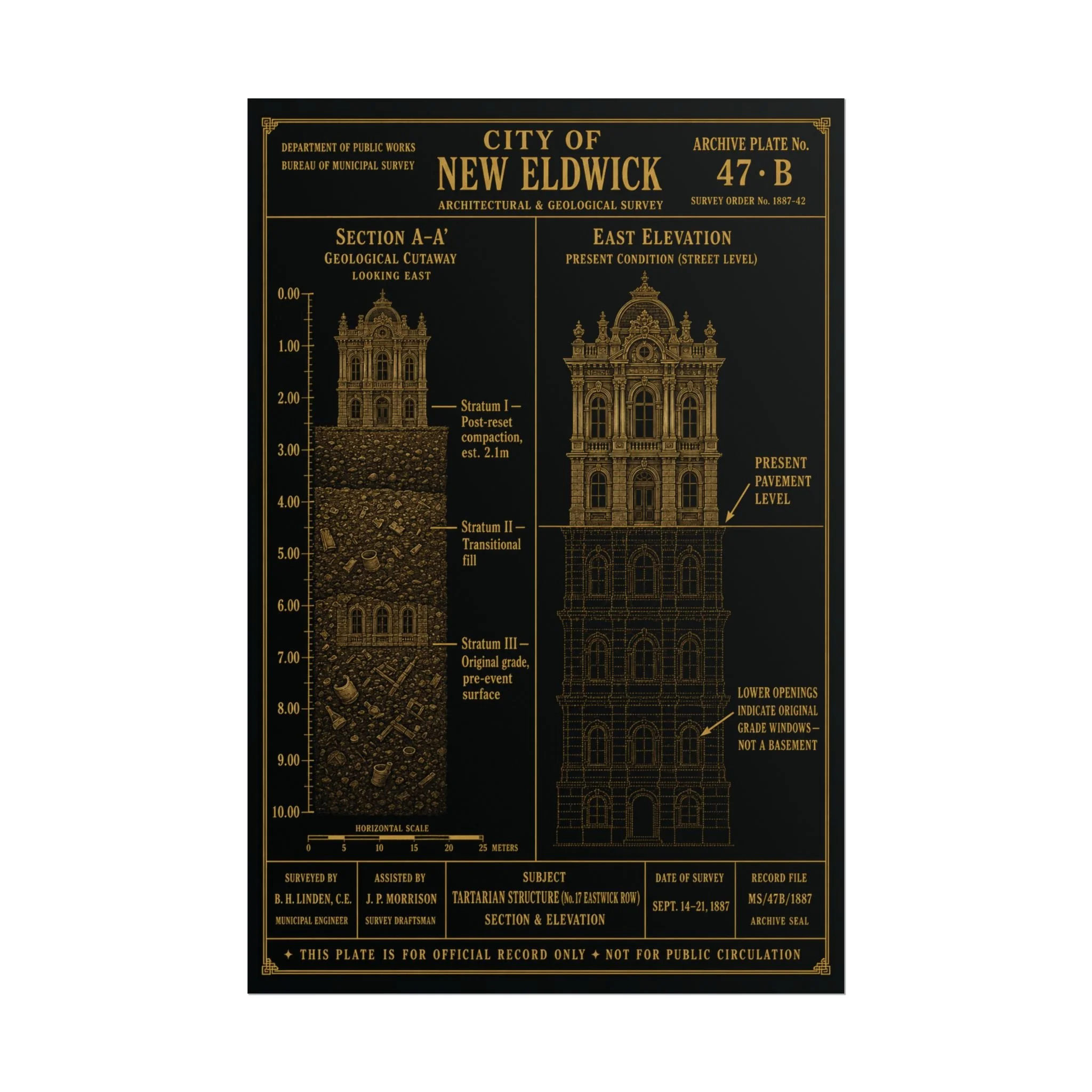
Archive Plate 47·B, City of New Eldwick. Bureau of Municipal Survey, Survey Order No. 1887-42. Not for public circulation.
Archive Plate 47·B, reproduced above, is one such document — rendered in the form and language of a genuine 19th-century municipal survey. Section A–A' shows the geological cutaway: three strata above the original grade, the building descending through them intact, its lower floors preserved in the sediment that covered them. The east elevation shows the same building as it stands at street level today: the grand entrance now partially buried, the lower arched windows now at basement depth, the original grade marked at approximately seven meters below the present pavement surface.
The survey does not speculate. It measures. It records. It files the plate under "official record only — not for public circulation" and moves on to the next assessment.
This is how institutional erasure works. Not through dramatic suppression. Through bureaucratic routine. Through the quiet normalization of anomalies that, examined honestly, should prompt much larger questions.
The Reset and What Came After
If the mud flood happened — if a civilization of the scale and sophistication that the buried architecture suggests was genuinely covered over — the question that follows is not just physical. It is historical and human.
What happened to the people?
Mud flood researchers point to the orphan trains of the 19th century, the foundling hospitals that appeared across Europe and America in the aftermath of the proposed event period, the strangely underpopulated official census records of the early 1800s. These are not proofs. They are data points that fit a pattern — the pattern of a world that lost an enormous portion of its population in a short period and then needed to repopulate, reorganize, and construct a new historical narrative to make the present world coherent.
The inheritors of the post-flood world faced a practical problem: they were surrounded by the infrastructure of a civilization they hadn't built and couldn't fully explain. The solution, in this reading, was to incorporate what remained into the new order. The grand buildings became government institutions, museums, train stations. Their buried lower floors became storage, service corridors, maintenance access. The architectural evidence of the prior civilization was repurposed rather than demolished, because the structures were too substantial to demolish and too useful to ignore.
What was demolished — or rather, what was rewritten — was the memory of who built them.
What Etherfolk Preserves
The Etherfolk archive does not argue. It does not debate. It does not attempt to persuade anyone of anything they are not already inclined to consider.
What it does is preserve the visual language of the inquiry — the forms and documents and artifacts that belong to the tradition of looking at the buried world and asking what is down there. The posters in the Hidden Histories Collection are not decorations. They are records. They are the kind of object that the people who believe the mud flood happened, and the people who are not yet sure, and the people who simply find the architecture beautiful and the history troubling — all of them can put on a wall and look at every day.
Buried But Not Forgotten shows the moment of emergence — a grand Tartarian city rising from the sediment, rendered in the style of a recovered archival illustration. Something unearthed, not commissioned.
Archive Plate 47·B shows the forensic record — the survey that was filed and forgotten, the measurements that don't add up, the building that descends seven meters below the street that was poured over it.
Together they constitute the beginning of a visual archive. There is more to document.
The Layers Don't Lie
The mud flood theory will not be resolved here. It will not be resolved anywhere that the historical establishment controls the terms of the inquiry. What can be resolved, by anyone willing to look, is the question of whether the anomalies exist.
They do. They are in the buildings. They are in the strata. They are in the municipal surveys filed under "official record only" and in the census records that show a world with far fewer people than the official history of civilizational continuity requires.
The mud came. The world was covered. The record was managed.
Some of what was buried is still there, waiting.
From the Archive
Both prints referenced in this article are available from the Etherfolk Hidden Histories Collection:
Buried But Not Forgotten — Mud Flood Tartaria Poster Print Museum-quality matte paper. 5″×7″ and 12″×16″. Some histories aren't lost. They're buried.
The Mud Flood Survey — Archive Plate 47·B Museum-quality matte paper. 12″×18″ only. This plate is for official record only. Not for public circulation.
Etherfolk is an independent archive exploring time, sky observation, symbolism, and the structures that shape perception. Preserving inquiry beyond standard narratives.